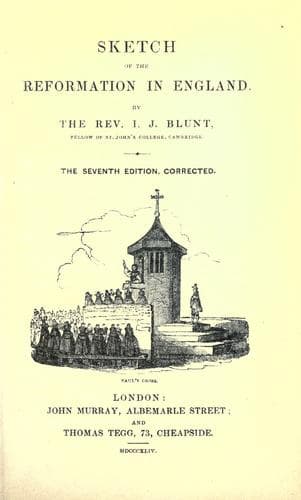
Sketch of the Reformation in EnglandBlunt, John J. (John James)
History
Sketch of the Reformation in England
Blunt, John J. (John James)
Great Britain -- Church history; Reformation -- England
What he did, however, he did ignorantly; not in any
carnal zeal, but after long debate, and as he writes, in bitterness
and sorrow of spirit.[349] He did it in the temper in which Sir Matthew
Hale condemned the witches of Leostoff, and suffered judgment to be
executed upon them; though he represents himself most unaffectedly,
and most truly, as having in general such tenderness in cases of life
as almost disqualified him for the bench; and though Sir Thomas Brown,
who actually wrote against vulgar errors, was in court at the time,
and influenced by his voice the verdict of the jury.[350] But in this
case, Cranmer seems to have thought that the honour of Christ himself,
which was blasphemed, required an example to be made; and, weak and
wicked as it is now allowed to be to condemn to the flames for matters
of speculative opinion, which do not directly interfere with the morals
of society, and therefore do not demand the interposition of the
secular magistrate, it was the dogma of the church in which Cranmer had
been born and bred: from which even yet he had not wholly emancipated
himself; but to which Edward, happily for himself and his country, had
never been enslaved. The case of Van Paris the Dutchman is usually
coupled with this of Joan Bocher; but there is no sufficient proof
that Cranmer was here a party actively engaged, or that any blame is
due to him, unless it be that he did not intercede for his life. It is
singular, and characteristic of the force of early prejudice, that in
the touching confession which Cranmer made before he went to the stake,
no allusion is found to the case of this poor fanatic.
Such was the child to whose hand Providence committed the sceptre of
England for a short season, “Ostendunt terris hunc tantum fata;” and
accordingly the church had rest in those days. The Roman Catholic
party, which had so effectually clogged the wheels of the Reformation
in the latter years of Henry, did not resign their power without a
struggle under Edward. From amongst the guardians of the king, who were
also to be the governors of the kingdom during the minority, the Earl
of Hertford, afterwards Duke of Somerset, the king’s maternal uncle,
and a friend of the Reformation, was chosen head of the regency, under
the title of Protector; whilst Wriothesley, the lord chancellor, a
Catholic, and the leader of his sect, who opposed the elevation of
Somerset, hoping that, if all the members were equal in authority,
the substantial power would be his own, was deposed from his office,
and deprived of the seals. Cranmer was in his own right, as primate,
a member of this commission; and finding a cordial coadjutor in the
Protector, he now felt himself released from the vexatious restrictions
which had hitherto cramped him, and began for the first time to breathe
freely. Now, therefore, his plans for restoring the national church
rapidly develope themselves, and to the consideration of these our
attention must for the present be directed.
Public-domain text, read in full here on John Shaqi.
Reviews
Reviews
No reviews yet
Be the first to share your thoughts on this work.
Elsewhere in the archive
Join the Discussion
Join the discussion
Sign in to leave a comment or review.
Sign InorCreate an account