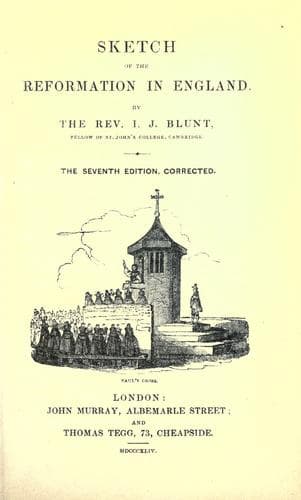
Sketch of the Reformation in EnglandBlunt, John J. (John James)
History
Sketch of the Reformation in England
Blunt, John J. (John James)
Great Britain -- Church history; Reformation -- England
It would be easy to take a more extensive sweep of contemporary
history, as others have done, and to adorn our narrative with the
spoils--for the stirring times here treated of, supply abundant
materials for such a purpose; but it is better, perhaps, to follow
our subject closely up, putting aside many collateral incidents, not,
indeed, as without their influence on the Reformation, but as holding
a very subordinate place in it; and thus to keep our eye single,
neither distracting it by too much diversity, nor perplexing it by too
much detail. For, in general, the most profitable method of treating
a complicated subject, perhaps, is, not to open up every particular,
great and small, which may bear upon it in its degree; but rather to
filter the rush of matter which presents itself, and, striving to make
a small book, which is a hard thing, instead of a large one, which
is most easy, to place the reader in possession of such events only
as served to stamp the times to which they belonged, or serve now to
characterise them, and then to leave him to his own reflection or to
his own study to fill up the picture.
The first of those successive publications, by the circulation of
which Cranmer built up the faith of his country, was _Erasmus’s
Paraphrase of the New Testament_, translated into English, a copy
of which, as well as of the Bible, was to be set up in every parish
church; the next, a volume of _Homilies_, twelve in number. The
paraphrase Cranmer himself did not maintain to be perfect; but it
was the best upon which he could lay his hand; moreover, as executed
by a member of the church of Rome, (from whose eyes, however, the
scales were fast falling,) it was calculated, he might think (and an
expression which drops from him confirms this),[351] for a church in
a state of transition like our own; Gardiner offered many captious
objections to it; others, which might have been urged with more show of
reason, he was not, perhaps, the man to discover or propound. Had he
compared it with similar writings of some other of the reformers, he
would have found that, in making such a choice, Cranmer, so far from
intending to irritate, could only be led by a desire to conciliate the
Catholics as much as might be without a compromise. Had he compared,
for instance, Erasmus’s paraphrase of the Galatians with the commentary
of Luther on the same epistle--had he contrasted the caution of the one
interpreter with the intrepidity, not to say hardihood, of the other;
the different degrees of animation with which the great evangelical
doctrines, and those the most obnoxious to the Roman catholics, are
respectively handled by them; the different degrees of keenness they
discover in the detection of those doctrines under the same texts;
the more or less reserved sense in which the works of the law are
understood as affecting justification; not to speak of the direct
fulminations against the church of Rome, which Luther takes every
Public-domain text, read in full here on John Shaqi.
Reviews
Reviews
No reviews yet
Be the first to share your thoughts on this work.
Elsewhere in the archive
Join the Discussion
Join the discussion
Sign in to leave a comment or review.
Sign InorCreate an account