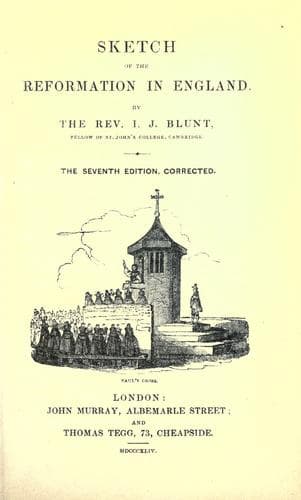
Sketch of the Reformation in EnglandBlunt, John J. (John James)
History
Sketch of the Reformation in England
Blunt, John J. (John James)
Great Britain -- Church history; Reformation -- England
occasion to launch, and Erasmus to withhold;--if he had thus done,
probably Luther’s most powerful treatise would not, indeed, have made
him a convert to his opinions; Cranmer himself most likely would have
disavowed, or at least tempered, several of them; but it would have
at any rate satisfied him that the archbishop had far more offensive
weapons in his armoury than those which he thought proper on this
occasion to produce.
The objections which Gardiner directed against the _Homilies_ were
many of them just enough in logic, though feeble in themselves, for
it was alleged, that the doctrines of the Homilies and of the King’s
Book did not always agree; nor did they: but this only served to show
(what was the truth) that, when the latter was published, Cranmer was
counteracted by other influence; or else (what was equally the truth)
that his own opinions had in the interval undergone considerable
revision. Justification by faith only, a doctrine which in the King’s
Book had been greatly qualified, is made a leading principle in the
Homilies; and certain superstitions of the church of Rome, which in the
former were tolerated, if not encouraged, in the latter were absolutely
forbidden.[352] It may be noticed, in passing, that on some points, as
on that of human corruption for instance, a tone of greater moderation
prevails in this book of the Homilies than in the other, which appeared
in 1562, prepared by Queen Elizabeth’s bishops, principally, it
has been said, by Jewel.[353] Such a volume had been promised in an
advertisement affixed to the former one; and many of the subjects
actually treated in it are there enumerated, though not all: but the
composition, it should seem, was reserved for those who completed the
Reformation. In neither case, however, can the several Homilies be
assigned to their several authors with any certainty. At the same time
in the first volume (for with regard to the second no single Homily
of them all has been appropriated,) there is reason to think that the
one on “salvation” is Cranmer’s own; as perhaps those on “faith” and
“good works;”[354] and internal evidence arising out of certain homely
expressions, and peculiar forms of ejaculation, the like to which occur
in Latimer’s sermons, pretty clearly betrays the hand of the Bishop
of Worcester to have been engaged in the homily against “brawling and
contention;” the one against “adultery” may be safely given to Thomas
Becon, one of Cranmer’s chaplains, in whose works, published in 1564,
it is still to be found; of the rest nothing is known but by the merest
conjecture.[355] On the whole, the key to the right understanding of
either volume is not the Calvinistic controversy; for amongst all
the Homilies, as Bishop Burnet observes, there are none relating to
the divine decrees[356]--but the horror of papal abuses, which drove
the compilers into some hearty expressions in contradiction to them,
particularly in those for the Nativity and Whitsunday--expressions
Public-domain text, read in full here on John Shaqi.
Reviews
Reviews
No reviews yet
Be the first to share your thoughts on this work.
Elsewhere in the archive
Join the Discussion
Join the discussion
Sign in to leave a comment or review.
Sign InorCreate an account