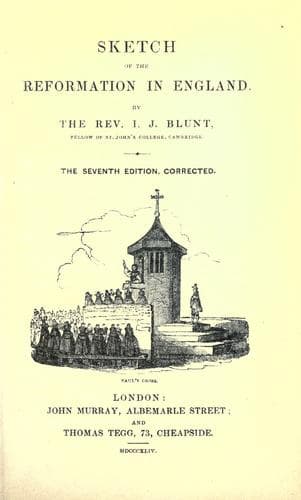
Sketch of the Reformation in EnglandBlunt, John J. (John James)
History
Sketch of the Reformation in England
Blunt, John J. (John James)
Great Britain -- Church history; Reformation -- England
There were those who reminded Mary
that she was by this measure impairing the dignity of the crown; but
to such she honestly made answer, that “she set more by the salvation
of her soul than by ten kingdoms.” Happy would it have been if her
devotedness to the church in which she had been bred had shown itself
in no less objectionable way than this. Prelates there were, of her
own party too, who, had they been permitted to be keepers of such
a conscience, would have guided it for good, for there was much in
this sturdiness of purpose to be improved. Such a man was Tonstall,
perhaps such a man was Pole; but she had surrendered herself to
cruel advisers; and soon became persuaded, that when she was putting
honest men to death, or driving them into exile, she was doing God
service. Accordingly, a proclamation was now issued for expelling all
foreigners, many of whom had established themselves in England under
the encouragement of Cranmer, and had contributed at once by their
religious opinions and their scholarship to forward the Reformation,
and by their skill in manufactures to develope the industry of the
country. Together with these not fewer than eight hundred Englishmen,
students chiefly, anticipating more unquiet times still, also withdrew;
and betaking themselves to Frankfort, Strasburgh, Basle, Zurich,
Geneva, and other places, there contracted a disaffection for the
church of England, such as paved the way for the crisis which came
with the civil wars. The Queen’s marriage with Philip only tended to
confirm her prejudices. He was a bigot at heart, though sometimes of
fair profession; and of a bigoted nation; and his unwelcome arrival in
England was but a signal for riots among the people, and still greater
severity on the part of the government. Joan of Kent and the Dutchman
had been executed, probably under the law against Anabaptists, enacted
in Henry VIII.’s reign, a sect politically dangerous,[428] since they
maintained community of goods, the duty of destroying the ungodly, and
antinomianism in general. It was now, however, thought advisable to
have a clearer warrant for the death of heretics, which was meditated
upon a great scale; and the statutes against the Lollards, enacted
under Richard II., Henry IV., and Henry V., were revived.[429] Gardiner
has the infamous credit of the measure, though in its application he
seems to have had some misgiving; and after convicting a few persons,
and those the leaders of the Reformation, (he was even said to be
bending his bow at the chief deer of all, the Lady Elizabeth,) he
became weary of his work, and made over the service of blood to one
who took his pastime in it like a leech--the brutal Bonner.[430]
Fuller, who has no love for the Bishop of Winchester in general, makes
grateful mention of an act of mercy done by him to his own maternal
great-grandmother, one Mrs. Clark, who having ministered to the wants
of the bishop when threatened with consumption and living in retirement
Public-domain text, read in full here on John Shaqi.
Reviews
Reviews
No reviews yet
Be the first to share your thoughts on this work.
Elsewhere in the archive
Join the Discussion
Join the discussion
Sign in to leave a comment or review.
Sign InorCreate an account