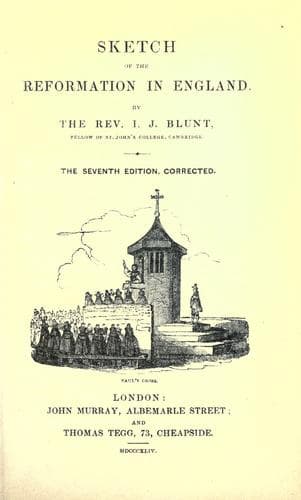
Sketch of the Reformation in EnglandBlunt, John J. (John James)
History
Sketch of the Reformation in England
Blunt, John J. (John James)
Great Britain -- Church history; Reformation -- England
for a while at Farnham Castle, at that time her residence, was allowed
to abide in her heresy (for she held the reformed faith), with his
connivance, and was even protected from the violence of others by his
authority. It is pleasant to be able to produce any redeeming incident
in these days of horror; for
“as the candle in the dark,
So shines a good deed in a naughty world.”
Isaac Walton exhorts his fisherman, when baiting with a frog, “to put
his hook through the mouth and out at his gills, and then with a fine
needle and silk to sew the upper part of his leg with only one stitch
to the arming wire of the hook, and in so doing to use him as though
he loved him.” And in the like compassionate spirit was it required
“in the bowels of the Lord Jesus Christ,” of those whose office it
was to burn men alive, “that the execution and punishment might be
so moderated that the rigour thereof might not be too extreme;”[431]
besides which it was the Queen’s particular desire that, both in London
and elsewhere, there should be “good sermons” preached at the time
of carrying the sentence into effect; so that whatever might be said
of the act itself, there was nothing to offend the most fastidious
philanthropy in the ceremonial.
For a history of that noble army of martyrs of whom it now becomes
our duty to speak, we are indebted to John Fox, himself an exile in
Mary’s reign, and like most of those who then lived abroad, a friend
of the Puritan principles at home. He had access to the archives and
registers of the bishops; Grindal, who was himself a great collector
of such materials, amongst others supplying him with what he knew;
and in many instances to the letters of the martyrs themselves;[432]
of all which documents, says Strype, he has been found, by those who
have compared his books with his authorities, to have made a faithful
use. He lived many years after his first edition was published, which
was in 1563, and in the interval laboured to render it still more
perfect; suppressing where he found reason to doubt, as in the story
of Cranmer’s heart remaining unconsumed when the rest of his body was
reduced to ashes;[433] enlarging where he was furnished with fresh
matter which he thought trustworthy, as in the story of Gardiner’s
being stricken with sickness on the day of Cranmer’s martyrdom;[434]
and taking journeys in order to confront witnesses and sift
evidence when his facts chanced to be called in question;[435] such
was his industry. But, independently of all knowledge of this, his
pains-taking, the internal evidence of the book is enough to establish
its general good faith. There is a simplicity in the narrative,
particularly in many of its minute details, which is beyond all
fiction; a homely pathos in the stories which art could not reach.
Sometimes an expression casually drops out which suffices to prove
the testimony to be that of an eye-witness; thus where the terrible
Public-domain text, read in full here on John Shaqi.
Reviews
Reviews
No reviews yet
Be the first to share your thoughts on this work.
Elsewhere in the archive
Join the Discussion
Join the discussion
Sign in to leave a comment or review.
Sign InorCreate an account