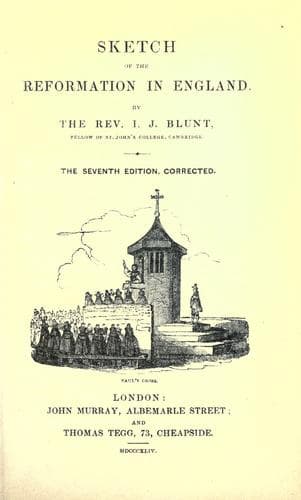
Sketch of the Reformation in EnglandBlunt, John J. (John James)
History
Sketch of the Reformation in England
Blunt, John J. (John James)
Great Britain -- Church history; Reformation -- England
death of Ridley is described, the martyrologist speaks in general in
his own person; yet we read, that “after the legs of the sufferer were
consumed by reason of his struggling through the pain, he showed that
side toward _us_ clean, shirt and all untouched with flame,” as
though the informant (whose words the historian had here neglected
to accommodate) had been himself the spectator. Sometimes there is a
frank confession of ignorance, where a less scrupulous writer would
have been under a great temptation to supply the defect of information
by conjecture; thus, in the details of the same execution of Ridley
and Latimer, it is observed, that after they rose from their knees the
one talked with the other a little while, but what they said, adds
Fox, “I can learn of no man.” Above all, there is such candour in the
development even of his most favourite characters, their failings
as well as their virtues so fairly told, that it is plain they have
not been packed. Thus it is by him we are taught that Cranmer moved
the king to the execution of Joan of Kent, though Cranmer’s general
disposition would seem repugnant to such an office, and though
no mention is made in Edward’s Journal of any such interference,
or, indeed, of any reluctance on his own part which should render
it needful: thus of Latimer he does not conceal that he probably
subscribed on one occasion certain articles which the bishops presented
to him, of fear rather than of conscience;[436] and of Hooper, his
favourite, if he had one among the martyrs, that he disputed too
pertinaciously and to the breach of mutual charity, with his opponents
on the subject of the episcopal habits, and that the prospect of their
approaching death for the common cause, and nothing less, could effect
the cordial union of the parties. Neither does he suppress any instance
of kindness by which the sufferings of the martyrs were mitigated; and
as St. Luke tells us of the centurion entreating Paul courteously, so
does Fox relate of Saunders, that when his wife came to the prison
gate, with her young child in her arms to visit her husband, the
keeper, though he durst not suffer her to enter the prison, yet took
the little babe out of her arms and brought him to his father, to his
exceeding great joy: and of Hooper’s guard, that they interceded with
the sheriffs of Gloucester on behalf of their charge, that he might
not be sent to the common gaol, they declaring at large how quietly,
mildly, and patiently he had behaved himself in the way, and adding,
that they would rather themselves be at the pains to watch with him
than that he should be so handled: and of Rowland Taylor, that his wife
and son Thomas were permitted to sup with him in the Counter, “by the
gentleness of his keepers,” and afterwards, that of his guard three out
of the four used him friendly. It was to be expected that a work which,
had it been published a few years sooner, (supposing this possible,)
Public-domain text, read in full here on John Shaqi.
Reviews
Reviews
No reviews yet
Be the first to share your thoughts on this work.
Elsewhere in the archive
Join the Discussion
Join the discussion
Sign in to leave a comment or review.
Sign InorCreate an account