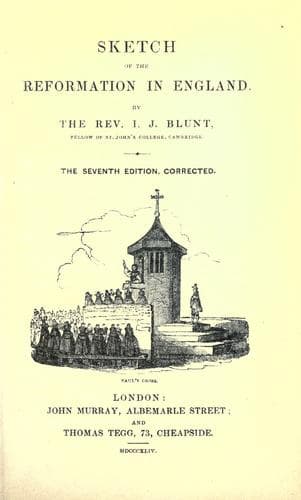
Sketch of the Reformation in EnglandBlunt, John J. (John James)
History
Sketch of the Reformation in England
Blunt, John J. (John James)
Great Britain -- Church history; Reformation -- England
Latimer was a man of more humble birth than the two former, being
a small farmer’s son at Thurcaston, in Leicestershire, a condition
in life which qualified him, perhaps, so eminently for spreading
the doctrines of the Reformation amongst the people, whose tastes
and phraseology, as well as their failings and faults, he, of all
the leading Reformers, seems to have best understood; and he was
accordingly honoured by the title of the Apostle of England. Fastidious
hearers would indeed find much to shock them in the homely speech and
extravagant jokes of Latimer, though probably in this he did but follow
an example which the friars had set him; but the earnest sincerity
of the man overcame all obstacles, and recommended him to the court,
as well as to the country, for an engine of the Reformation powerful
beyond most others. The see of Worcester, to which he was elected by
Henry, he took the first opportunity of resigning; an opportunity given
him by the Act of the Six Articles, and when he might have resumed it
he held back, living with Cranmer at Lambeth, as a private individual,
accessible to suitors, whose cases he forwarded to the primate; greeted
by the people still with the title of Lord, for they rejoiced to pay
him honour; and the favourite even of the boys in the streets, who
cheered him as he approached his ever popular pulpit with some hearty
word of encouragement to say on. Still there was something in Latimer
(even in those times, when it was not much the practice of the preacher
to go bridle in hand,) which seems to have stamped him as a humourist
amongst his unrefined contemporaries; and a few words of advice which
Cranmer gives him in a letter written when he was about to make his
first essay as a preacher at court--a situation to which the archbishop
had himself introduced him--indicate that he looked upon the experiment
not without some little apprehension for the result. “Overpass or
omit,” says the discreet adviser, “all manner of speech either apertly
or suspiciously sounding against any _special_ man’s facts,
manners, or sayings, to the intent your audience have none occasion
thereby, namely, to slander your adversaries, which would seem to many
that you were void of charity, and so much the more unworthy to occupy
that room. Nevertheless, if such occasion be given by the word of God,
let none offence or suspicion be unreprehended, especially if it be
_generally_ spoken, without affection. Furthermore, I would that
you should so study to comprehend your matter, that in any condition
you stand no longer in the pulpit than an _hour or an hour and
half_ at the most, for by long expense of time, the King and the
Queen (Anne Bullen) shall peradventure wax so weary at the beginning
that they shall have small delight to continue throughout with you to
the end.”[447]
Public-domain text, read in full here on John Shaqi.
Reviews
Reviews
No reviews yet
Be the first to share your thoughts on this work.
Elsewhere in the archive
Join the Discussion
Join the discussion
Sign in to leave a comment or review.
Sign InorCreate an account