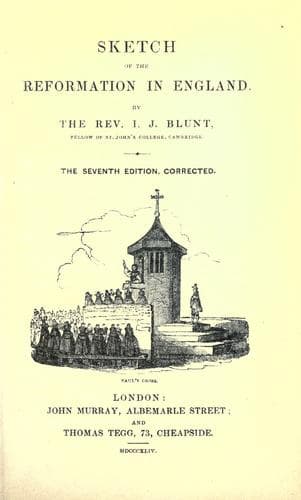
Sketch of the Reformation in EnglandBlunt, John J. (John James)
History
Sketch of the Reformation in England
Blunt, John J. (John James)
Great Britain -- Church history; Reformation -- England
The glory of this contest (as we find it detailed in Fox)[448]
certainly rests with Ridley, rather than with Cranmer, who had probably
less nerve, or Latimer who had less learning. He adheres to one line
of argument--that of explaining all the authorities advanced against
him of the _spiritual_ presence only; and this he does with a
knowledge of his subject, as well as a readiness in applying it; such
as argue an extent of reading, a tenacity of memory, and a presence of
mind, quite wonderful. Be they passages from Scripture, from fathers,
or from the canons of councils, with which he is plied, they appear to
be the last things which he had examined, so that a false reading, or
a false gloss, or a packed quotation, never escapes him; and either
a minute knowledge of an author’s text, or (what is often quite as
certain a proof of scholarship) an accurate perception of the general
spirit which influences him, enables him to wrest the weapon from the
hands of his adversaries, and to turn it against themselves. “If there
was an Arian,” exclaimed one of them, in the bitterness of defeat,
“which had that subtle wit that you have, he might soon shift off the
authority of the Scriptures and fathers.” All, however, was to little
purpose before judges who, like Virgil’s Rhadamanthus, were bent upon
punishing first and convicting afterwards. Sentence was passed in St.
Mary’s Church, where Cranmer, Ridley, and Latimer were convened; in the
course of it, they were asked by the commissioners whether they would
turn or no; but they bade them “read on in the name of God, for that
they were not minded to turn; and so were they condemned all three.”
It was intended to act the same scene over again at Cambridge, where
Hooper, Bradford, Taylor, Philpot, and some others not yet put to
death, were to be baited; but they had received timely information of
the treatment of their companions at the sister university, and refused
to dispute, except in writing, or before the Queen, or either house of
parliament, and, accordingly, the tyrannous scheme was in this instance
abortive.
Public-domain text, read in full here on John Shaqi.
Reviews
Reviews
No reviews yet
Be the first to share your thoughts on this work.
Elsewhere in the archive
Join the Discussion
Join the discussion
Sign in to leave a comment or review.
Sign InorCreate an account