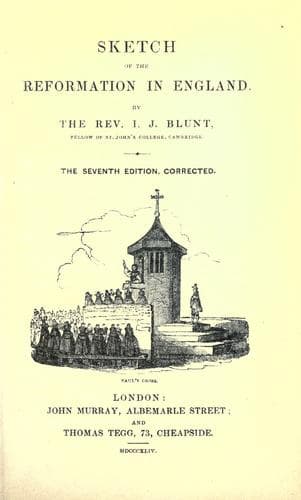
Sketch of the Reformation in EnglandBlunt, John J. (John James)
History
Sketch of the Reformation in England
Blunt, John J. (John James)
Great Britain -- Church history; Reformation -- England
the devil; neither would he leave them so, but would also severely
and straitly hold them in by _lawful and politic punishments_,
if they fortune to break out any where and bewray themselves.[479]
These are very strong words. And what is more remarkable still, a
similar line was adopted, nearly a hundred years later, by one who
has been considered the great champion of religious liberty, and in
a work expressly dedicated to the extension of it, and though it is
more than probable that Jeremy Taylor, here, as elsewhere, would not
have had the courage to follow out his own argument to its practical
results, and would have shrunk from “putting to death or dismembering”
the professing Christian, even for “impiety or blasphemy,” or for
opinions (if only such), however “destructive of the foundation of
religion;”[480] yet the theory itself, re-asserted after so long an
interval, and by such an advocate, is enough to prove that Cranmer was
rather in advance of his generation than behind it; and that he is
still to be regarded as the reformer, and not as the bigot.
But there is reason to think that the capital penalties even of his
code would have been mitigated, had he ever actually presented it
to the legislature. Cranmer was becoming daily more tolerant, as he
gradually fell under the influence of a more charitable faith. He had
been shocked, it is said, by the solemn manner in which Edward made
him responsible before God for the life of Joan of Kent; he expressed
himself shortly afterwards of Gardiner in terms significant of a
repugnance to severities;[481] and he was one of those who advised
connivance at the use of the mass by the Princess Mary. With these
tokens of temper before us, it seems fair to infer, that however
greatly Cranmer coveted the establishment of discipline, he would
scarcely have bought it at the price of blood; and that his own
character, by nature one of the most gentle, was asserting itself more
and more even in matters calculated to put it most of all to the
proof. But if discipline, properly so called, be lacking, so much the
rather should those ecclesiastical regulations which are of imperfect
obligation perhaps (and there are many such) be diligently observed
by the clergy, both towards those set over them, and towards those
committed to their charge; the respect or neglect of which is just that
which constitutes the decency or disorder of a church; a distinction
not easy to describe in detail, yet sufficiently intelligible in
itself; nor is it unreasonable to expect that the laity on their part
should see the advantage of such rules, which cannot be onerous, and
cordially co-operate with the clergy to the maintenance of them.
Public-domain text, read in full here on John Shaqi.
Reviews
Reviews
No reviews yet
Be the first to share your thoughts on this work.
Elsewhere in the archive
Join the Discussion
Join the discussion
Sign in to leave a comment or review.
Sign InorCreate an account