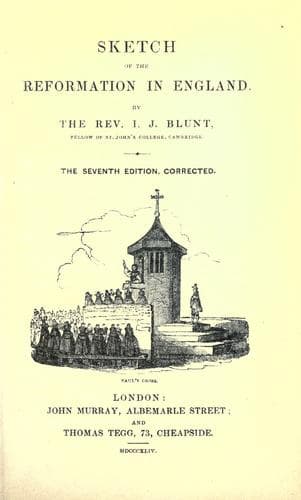
Sketch of the Reformation in EnglandBlunt, John J. (John James)
History
Sketch of the Reformation in England
Blunt, John J. (John James)
Great Britain -- Church history; Reformation -- England
pleasurable; and who had found that there was but small satisfaction in
the enjoyment “of that fugitive and cloistered virtue, that shrunk from
the race when the prize was to be won not without dust and heat.”[250]
Amidst the strife of tongues, which those tempestuous times called
forth, it is almost hopeless to come at the exact truth. On the one
hand, the visiters are charged with inordinate rapacity, with private
embezzlement of the vast property lying at their mercy, and even
with abusing the opportunities which their commission gave them, and
corrupting the nuns. They, on the other hand, retaliated by presenting
to the eyes of the people a most revolting picture of the interior of
these whited sepulchres (for such they were described to be) fair on
the outside, but within full of dead men’s bones, and all uncleanness,
of spurious relics and sensual sins, and the foulness of the picture
helped to relieve the King from the odium of destroying it.
Yet, bad as the monasteries were reported to be, and bad in many
instances they probably were, (for the system was in some respects
radically pernicious,) the event proved that they had their redeeming
qualities too; and as we know not, says the proverb, what the well is
worth till it is dry, so was it found after the dissolution, that,
with all their faults, the monasteries had been the refuge for the
destitute who were now driven to frightful extremities throughout the
country, the effect of the suppression being with respect to them the
same as would now follow from the sudden abolition of the poor laws;
they had been the alms-houses, where the aged dependants of more
opulent families, the decrepid servant, the decayed artificer, retired
as to a home neither uncomfortable nor humiliating; that they had
been the county infirmaries and dispensaries, a knowledge of medicine
and of the virtues of herbs being a department of monkish learning
(as passages in the old dramatic writers sometimes indicate,) and
a hospital, and, perhaps, a laboratory, being component parts of a
monkish establishment; that they had been foundling asylums, relieving
the state of many orphan and outcast children, and ministering to their
necessities, God’s ravens in the wilderness, (neither so black as they
had been represented,) bread and flesh in the morning, and bread and
flesh in the evening;[251] that they had been inns for the way-faring
man, who heard from afar the sound of the vesper bell, at once inviting
him to repose and devotion, and who might sing his matins with the
morning star, and go on his way rejoicing; that they filled up the gap
in which the public libraries have since stood, and if their inmates
were not very desirous to eat of the tree of knowledge themselves,
they had at least the merit of cherishing and preserving it alive
for others. Thus do we find in the monastic system a provision made
for many of those wants of society which public institutions are now
Public-domain text, read in full here on John Shaqi.
Reviews
Reviews
No reviews yet
Be the first to share your thoughts on this work.
Elsewhere in the archive
Join the Discussion
Join the discussion
Sign in to leave a comment or review.
Sign InorCreate an account