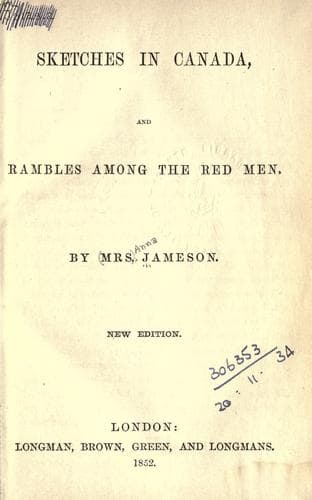
Sketches in Canada, and rambles among the red menJameson, Mrs. (Anna)
History
Sketches in Canada, and rambles among the red men
Jameson, Mrs. (Anna)
Indians of North America -- Canada; Ontario -- Description and travel
I had once some conversation with Thalberg and Felix Mendelssohn, on the
unmeaning names which musicians often give to their works, as "Concerto
in F," "Concerto in B flat," "First Symphony," "Second Symphony," &c.
Mendelssohn said, that though in almost every case the composer might
have a leading idea, it would be often difficult, or even impossible, to
give any title sufficiently comprehensive to convey the same idea or
feeling to the mind of the hearer.
But music, except to musicians, can only give ideas, or rather raise
images, by association; it can give the pleasure which the just
accordance of musical sounds must give to sensitive ears, but the
associated ideas or images, if any, must be quite accidental. Haydn, we
are told, when he sat down to compose, used first to invent a story in
his own fancy--a regular succession of imaginary incidents and
feelings--to which he framed or suited the successive movements (motivi)
of his concerto. Would it not have been an advantage if Haydn could have
given to his composition such a title as would have pitched the
imagination of the listener at once upon the same key? Mendelssohn
himself has done this in the pieces which he has entitled "Overture to
Melusina," "Overture to the Hebrides," "Meeres Stille und Glückliche
Fahrt," "The Brook," and others,--which is better surely than Sonata No.
1, Sonata No. 2. Take the Melusina, for example; is there not in the
sentiment of the music all the sentiment of the beautiful old fairy
tale?--first, in the flowing, intermingling harmony, we have the soft
elemental delicacy of the water nymph; then, the gushing of fountains,
the undulating waves; then the martial prowess of the knightly lover,
and the splendour of chivalry prevailing over the softer and more
ethereal nature; and then, at last, the dissolution of the charm; the
ebbing, fainting, and failing away into silence of the beautiful water
spirit. You will say it might answer just as well for Ondine; but this
signifies little, provided we have our fancy pitched to certain poetical
associations pre-existing in the composer's mind. Thus not only poems,
but pictures and statues, might be set to music. I suggested to Thalberg
as a subject the Aurora of Guido. It should begin with a slow, subdued,
and solemn movement, to express the slumbrous softness of that dewy hour
which precedes the coming of the day, and which in the picture broods
over the distant landscape, still wrapt in darkness and sleep; then the
stealing upwards of the gradual dawn; the brightening, the quickening of
all life; the awakening of the birds, the burst of the sun-light, the
rushing of the steeds of Hyperion through the sky, the aerial dance of
the Hours, and the whole concluding with a magnificent choral song of
triumph and rejoicing sent up from universal nature.
Public-domain text, read in full here on John Shaqi.
Reviews
Reviews
No reviews yet
Be the first to share your thoughts on this work.
Join the Discussion
Join the discussion
Sign in to leave a comment or review.
Sign InorCreate an account