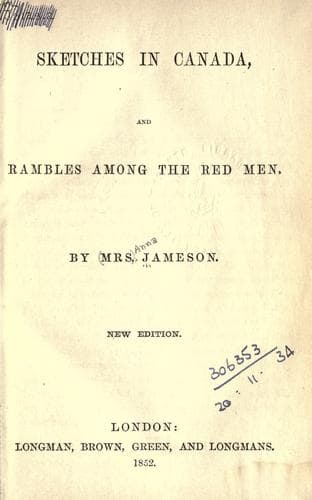
Sketches in Canada, and rambles among the red menJameson, Mrs. (Anna)
History
Sketches in Canada, and rambles among the red men
Jameson, Mrs. (Anna)
Indians of North America -- Canada; Ontario -- Description and travel
And then in the same spirit--no, in his own grander spirit--I would have
Mendelssohn improviser the Laocoon. There would be the pomp and
procession of the sacrifice on the seashore; the flowing in of the
waves; the two serpents which come gliding on their foamy crests,
wreathing, and rearing, and undulating; the horror, the lamentation, the
clash of confusion, the death struggle, and, after a deep pause, the
wail of lamentation, the funereal march;--the whole closing with a hymn
to Apollo. Can you not just imagine such a piece of music, and composed
by Mendelssohn? and can you not fancy the possibility of setting to
music in the same manner Raffaelle's Cupid and Psyche, or his Galatea,
or the group of the Niobe? Niobe would be a magnificent subject either
for a concerto, or for a kind of mythological oratorio.
* * * * *
March 2.
Turning over Boswell to-day, I came upon this passage: Johnson says, "I
do not commend a society where there is an agreement that what would not
otherwise be fair shall be fair; but I maintain that an individual of
any society who practises what is allowed is not dishonest."
What say you to this reasoning of our great moralist? does it not reduce
the whole moral law to something merely conventional?
In another place, Dr. Johnson asks, "What proportion does climate bear
to the complex system of human life." I shiver while I answer, "A good
deal, my dear Doctor, to some individuals, and yet more to whole races
of men."
He says afterwards, "I deal more in _notions_ than in facts." And so do
I, it seems.
He talks of "men being _held down_ in conversation by the presence of
women"--_held up_ rather, where moral feeling is concerned; and if held
down where intellect and social interests are concerned, then so much
the worse for such a state of society.
Johnson knew absolutely nothing about women. Witness that one assertion,
among others more insulting, that it is matter of indifference to a
woman whether her husband be faithful or not. He says, in another place,
"If we men require more perfection from women than from ourselves, it
is doing them honour."
Indeed! If, in exacting from us more perfection, you do not allow us the
higher and nobler nature, you do us not honour but gross injustice; and
if you do allow us the higher nature, and yet regard us as subject and
inferior, then the injustice is the greater. There, Doctor, is a dilemma
for you.
* * * * *
March 8.
Public-domain text, read in full here on John Shaqi.
Reviews
Reviews
No reviews yet
Be the first to share your thoughts on this work.
Join the Discussion
Join the discussion
Sign in to leave a comment or review.
Sign InorCreate an account