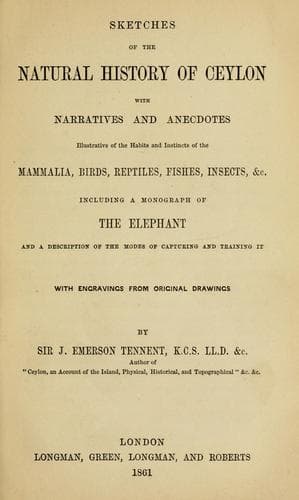
Sketches of the Natural History of CeylonTennent, James Emerson, Sir
Science
Sketches of the Natural History of Ceylon
Tennent, James Emerson, Sir
Animals -- Sri Lanka; Asiatic elephant -- Sri Lanka
in front receiving all these blows on the points of their weapons, the
extremity of the trunk becomes so sore that the animal curls it up
close, and seldom afterwards attempts to use it offensively. The first
dread of man's power being thus established, the process of taking him
to bathe between two tame elephants is greatly facilitated, and by
lengthening the neck rope, and drawing the feet together as close as
possible, the process of laying him down in the water is finally
accomplished by the keepers pressing the sharp point of their hendoos
over the backbone.
[Footnote 1: BRODERIP, _Zoological Recreations_, p. 226.]
[Footnote 2: The iron goad with which the keeper directs the movements
of the elephants, called a _hendoo_ in Ceylon and _hawkus_ in Bengal,
appears to have retained the present shape from the remotest antiquity.
It is figured in the medals of Caracalla in the identical form in which
it is in use at the present day in India.
The Greeks called it [Greek: harpê], and the Romans _cuspis_.
[Illustration: Medal of Numidia.]
[Illustration: Modern Hendoo.]]
For many days the roaring and resistance which attend the operation are
considerable, and it often requires the sagacious interference of the
tame elephants to control the refractory wild ones. It soon, however,
becomes practicable to leave the latter alone, only taking them to and
from the stall by the aid of a decoy. This step lasts, under ordinary
treatment, for about three weeks, when an elephant may be taken alone
with his legs hobbled, and a man walking backwards in front with the
point of the hendoo always presented to the elephant's head, and a
keeper with an iron crook at each ear. On getting into the water, the
fear of being pricked on his tender back induces him to lie down
directly on the crook being only held over him _in terrorem_. Once this
point has been achieved, the further process of taming is dependent upon
the disposition of the creature.
The greatest care is requisite, and daily medicines are applied to heal
the fearful wounds on the legs which even the softest ropes occasion.
This is the great difficulty of training; for the wounds fester
grievously, and months and sometimes years will elapse before an
elephant will allow his feet to be touched without indications of alarm
and anger.
Public-domain text, read in full here on John Shaqi.
Reviews
Reviews
No reviews yet
Be the first to share your thoughts on this work.
Elsewhere in the archive
Join the Discussion
Join the discussion
Sign in to leave a comment or review.
Sign InorCreate an account