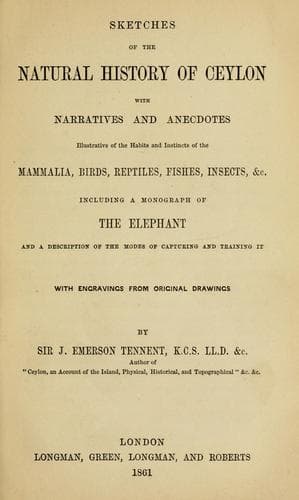
Sketches of the Natural History of CeylonTennent, James Emerson, Sir
Science
Sketches of the Natural History of Ceylon
Tennent, James Emerson, Sir
Animals -- Sri Lanka; Asiatic elephant -- Sri Lanka
It has been suggested that the bones of the elephant, may be so porous
and spongy as to disappear in consequence of an early decomposition; but
this remark would not apply to the grinders or to the tusks; besides
which, the inference is at variance with the fact, that not only the
horns and teeth, but entire skeletons of deer, are frequently found in
the districts inhabited by the elephant.
The natives, to account for this popular belief, declare that the
survivors of the herd bury such of their companions as die a natural
death.[1] It is curious that this belief was current also amongst the
Greeks of the Lower Empire; and PHILE, writing early in the fourteenth
century, not only describes the younger elephants as tending the
wounded, but as burying the dead:
[Greek: "Otan d' epistê tês teleutês o chronos Koinou telous amunan o
xenos pherei]."[2]
[Footnote 1: A corral was organised near Putlam in 1846, by Mr. Morris,
the chief officer of the district. It was constructed across one of the
paths which the elephants frequent in their frequent marches, and during
the course of the proceedings two of the captured elephants died. Their
carcases were left of course within the enclosure, which was abandoned
as soon as the capture was complete. The wild elephants resumed their
path through it, and a few days afterwards the headman reported to Mr.
Morris that the bodies had been removed and carried outside the corral
to a spot to which nothing but the elephants could have borne them.]
[Footnote 2: PHILE, _Expositio de Eleph._ l. 243.]
Public-domain text, read in full here on John Shaqi.
Reviews
Reviews
No reviews yet
Be the first to share your thoughts on this work.
Elsewhere in the archive
Join the Discussion
Join the discussion
Sign in to leave a comment or review.
Sign InorCreate an account