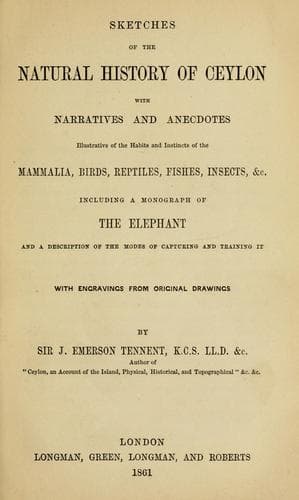
Sketches of the Natural History of CeylonTennent, James Emerson, Sir
Science
Sketches of the Natural History of Ceylon
Tennent, James Emerson, Sir
Animals -- Sri Lanka; Asiatic elephant -- Sri Lanka
An opportunity is afforded on the sea-shore of Ceylon for observing a
remarkable illustration of instinct in the turtle, when about to deposit
its eggs. As if conscious that if she went and returned by one and the
same line across the sandy beach, her hiding place would be discovered
at its farthest extremity, she resorts to the expedient of curving her
course, so as to regain the sea by a different track; and after
depositing the eggs, burying them about eighteen inches deep, she
carefully smoothes over the surface to render the precise spot
indiscernible. The Singhalese, aware of this device, sound her line of,
march with a rod till they come upon the concealed nest.
_Snakes_.--It is perhaps owing to the aversion excited by the ferocious
expression and unusual action of serpents, combined with an instinctive
dread of attack[1], that exaggerated ideas prevail both as to their
numbers in Ceylon, and the danger to be apprehended from encountering
them. The Singhalese profess to distinguish a great many kinds, of which
they say not more than one half have as yet been scientifically
identified[2]; but so cautiously do serpents make their appearance, that
the surprise of persons long resident is invariably expressed at the
rarity with which they are to be seen; and from my own journeys through
the jungle, often of from two to five hundred miles, I have frequently
returned without observing a single snake. Mr. Bennett, who resided much
in the south-east of the island, ascribes the rarity of serpents in the
jungle to the abundance of the wild peafowl, whose partiality to young
snakes renders them the chief destroyers of these reptiles. It is
likely, too, that they are killed by the jungle-cocks; for they are
frequently eaten by the common barn-door fowl in Ceylon. This is
rendered the more probable by the fact, that in those districts where
the extension of cultivation, and the visits of sportsmen, have reduced
the numbers of the jungle-cocks and pea-fowl, snakes have perceptibly
increased. The deer also are enemies of the snakes, and the natives who
have had opportunities of watching their encounters assert that they
have seen deer rush upon a serpent and crush it by leaping on it with
all its four feet. As to the venomous powers of snakes, DR. DAVY, whose
attention was carefully directed to the poisonous serpents of Ceylon[3],
came to the conclusion that but _four_, out of twenty species examined
by him, were venomous, and that of these only two (the _tic-polonga_[4]
and _cobra de capello_[5]) were capable of inflicting a wound likely to
be fatal to man. The third is the _carawala_[6], a brown snake of about
two feet in length; and for the fourth, of which only a few specimens
have been procured, the Singhalese have no name in their vernacular--a
proof that it is neither deadly nor abundant. But Dr. Davy's estimate of
the venom of the _carawala_ is below the truth, as cases have been
Public-domain text, read in full here on John Shaqi.
Reviews
Reviews
No reviews yet
Be the first to share your thoughts on this work.
Elsewhere in the archive
Join the Discussion
Join the discussion
Sign in to leave a comment or review.
Sign InorCreate an account