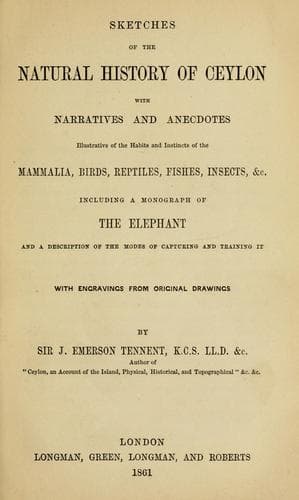
Sketches of the Natural History of CeylonTennent, James Emerson, Sir
Science
Sketches of the Natural History of Ceylon
Tennent, James Emerson, Sir
Animals -- Sri Lanka; Asiatic elephant -- Sri Lanka
authenticated to me, in which death from its bite ensued within a few
days. The effect, however, is not uniformly fatal; a circumstance which
the natives explain by asserting that there are three varieties of the
carawala, named the _hil-la_, the _dunu_, and the _mal_-carawala; the
second being the largest and the most dreaded.
[Footnote 1: Genesis iii. 15.]
[Footnote 2: This is not likely to be true: in a very large collection
of snakes made in Ceylon by Mr. C.R. Butler, and recently examined by
Dr. Günther, of the British Museum, only a single-specimen proved to be
new.
There is, however, one venomous snake, of the existence of which I am
assured by a native correspondent in Ceylon, no mention has yet been
made by European naturalists. It is called M[=a]pil[=a] by the
Singhalese; it is described to me as being about four feet in length, of
the diameter of the little finger, and of a uniform dark brown colour.
It is said to be often seen in company with another snake called in
Singhalese _Lay Medilla_, a name which implies its deep red hue. The
latter is believed to be venomous. It would be well if some collector in
Ceylon would send home for examination the species which respectively
bear these names.]
[Footnote 3: See DAVY'S _Ceylon_, ch. xiv.]
[Footnote 4: Daboia elegans, _Daud._]
[Footnote 5: Naja tripudians, _Merr._]
[Footnote 6: Trigonocephalus hypnale, _Merr._]
In like manner, the _tic-polonga_, particularised by Dr. Davy, is said
to be but one out of seven varieties of that formidable reptile. The
word "tic" means literally the "spotted" polonga, from the superior
clearness of the markings on its scales. Another, the _nidi_, or
"sleeping" polonga, is so called from the fact that a person bitten by
it is soon prostrated by a lethargy from which he never awakes.[1] These
formidable serpents so infested the official residence of the District
Judge of Trincomalie in 1858, as to compel his family to abandon it. In
another instance, a friend of mine, going hastily to take a supply of
wafers from an open tin case which stood in his office, drew back his
hand, on finding the box occupied by a tic-polonga coiled within it.
During my residence in Ceylon, I never heard of the death of a European
which was caused by the bite of a snake; and in the returns of coroners'
inquests made officially to my department, such accidents to the natives
appear chiefly to have happened at night, when the animal, having been
surprised or trodden on, inflicted the wound in self-defence.[2] For
these reasons the Singhalese, when obliged to leave their houses in the
dark, carry a stick with a loose ring, the noise[3] of which as they
strike it on the ground is sufficient to warn the snakes to leave their
path.
[Footnote 1: The other varieties are the _getta, lay, alu, kunu,_ and
_nil-polongas._ I have heard of an eighth, the _palla-polonga_.
Public-domain text, read in full here on John Shaqi.
Reviews
Reviews
No reviews yet
Be the first to share your thoughts on this work.
Elsewhere in the archive
Join the Discussion
Join the discussion
Sign in to leave a comment or review.
Sign InorCreate an account