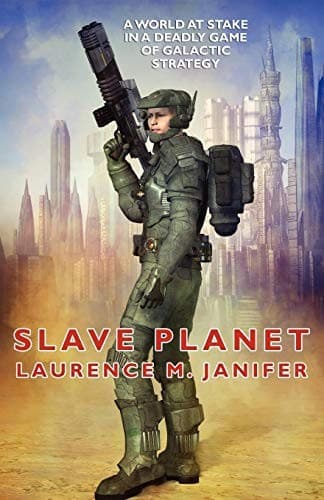
Life on other planets -- Fiction; Science fiction; Slavery -- Fiction
"There won't be any way to disguise the fact," Dr. Haenlingen said. "In
the long run, there never is. And the fact will shock them into action.
As long as they continue to live in that air of freedom and justice and
equality under the law, they'll want to stop what we're doing here.
They'll have to."
"I see," Nonna said. "Of course."
Dr. Haenlingen, still looking out at the world below, smiled faintly.
"Slavery," she said, "is such an _ugly_ word."
2
The Commons Room of the Third Building of City One was a large affair,
whose three bare metal walls enclosed more space than any other
single living-quarters room in the Building; but the presence of the
fourth wall made it seem tiny. That wall was nearly all window, a
non-shatterable clear plastic immensely superior to that laboratory
material, glass. It displayed a single unbroken sweep of forty feet,
and it looked down on the forests of Fruyling's World from a height of
sixteen stories. Men new to the Third Building usually sat with their
backs to that enormous window, and even the eldest inhabitants usually
placed their chairs somehow out of line with it, and looked instead at
the walls, at their companions, or at their own hands.
Fruyling's World was disturbing, and not only because of the choking
profusion of forest that always seemed to threaten the isolated
clusters of human residence. A man could get used to forests. But at
any moment, looking down or out across the gray-green vegetation, that
man might catch sight of a native--an Elder, perhaps heading slowly out
toward the Birth Huts hidden in the lashing trees, or a group of Small
Ones being herded into the Third Building itself for their training. It
was hard, perhaps impossible, to get used to that: when you had to see
the natives you steeled yourself for the job. When you didn't have to
see them you counted yourself lucky and called yourself relaxed.
It wasn't that the natives were hideous, either. Their very name had
been given to them by men in a kind of affectionate mockery, since
they weren't advanced enough even to have such a group-name of their
own as "the people." They were called Alberts, after a half-forgotten
character in a mistily-remembered comic strip dating back before space
travel, before the true beginnings of Confederation history. If you
ignored the single, Cyclopean eye, the rather musty smell and a few
other even more minor details, they looked rather like two-legged
alligators four feet tall, green as jewels, with hopeful grins on their
faces and an awkward, waddling walk like a penguin's. Seen without
preconceptions they might have been called cute.
But no man on Fruyling's World could see the Alberts without
preconceptions. They were not Alberts: they were slaves, as the men
were masters. And slavery, named and accepted, has traditionally been
harder on the master than the slave.
Public-domain text, read in full here on John Shaqi.
Reviews
Reviews
No reviews yet
Be the first to share your thoughts on this work.
Join the Discussion
Join the discussion
Sign in to leave a comment or review.
Sign InorCreate an account