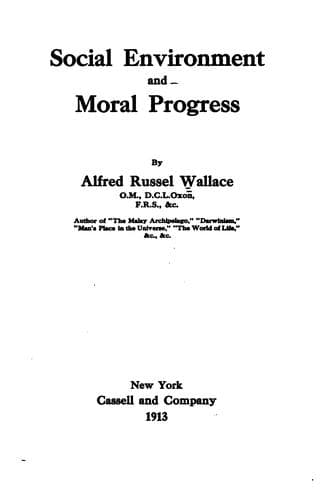
Social Environment and Moral ProgressWallace, Alfred Russel
Philosophy
Social Environment and Moral Progress
Wallace, Alfred Russel
Natural selection; Social ethics
Now, I wish to call attention to the very important fact that the
origin and development of speech, and later, of writing, were
apparently almost simultaneous, and certainly quite independent of
each other, in countries not very distant apart. This is shown by the
radical diversity of the different groups of languages in Europe,
Eastern Asia and North Africa, and the equal diversity of Egyptian,
Assyrian, and Chinese writing. All other written characters are
believed to be derived from one or other of these, and it is known that
the forms and peculiarities of alphabetic characters have been greatly
modified by the various materials employed, such as wood and stone
slabs, clay, or wax; papyrus, paper or parchment; and whether engraved,
impressed or painted, whether written with a reed or quill pen, or with
a small brush.
But if intellectual man as a species of mammal had developed by the
preservation of variations of survival-value, we should expect to
find such an important faculty as speech to have originated in one
centre and to have spread rapidly over the world with only slight
modifications in isolated communities. The fundamental diversities
we find seem to accord better with the conception that when, as a
mere animal, his material organism had reached the required degree of
perfection, there occurred the spiritual influx which alone enabled
him to begin that course of intellectual and moral development, and
that marvellous power over the forces of Nature, in which speech and
writing, followed by printing, have been such important factors.
In order for man to develop speech he must have possessed a brain and
an intellect far above that of the brutes. As in the more fundamental
problem of the origin of life, it is admitted that organisation is a
product of life—not life of organisation—so we must believe that
speech was a product of a brain and an intellect sufficient for their
development. But such brain and intellect were not necessary for the
lower animals, which have reached their highest lines of development in
the dog, horse, elephant, and ape without making any definite approach
to the acquirement of such higher faculties.
CHAPTER VI
SAVAGES NOT MORALLY INFERIOR TO CIVILISED RACES
If the facts and arguments set forth in the preceding chapters are
correct we should not expect to find any living examples of the
unspiritualised man, since the assumption is that the whole race
received the influx which started them on their course of purely human
development within a strictly limited period, perhaps of a very few
generations or even one generation. The ancestral form—the supposed
missing link—would then have become extinct.
Public-domain text, read in full here on John Shaqi.
Reviews
Reviews
No reviews yet
Be the first to share your thoughts on this work.
Join the Discussion
Join the discussion
Sign in to leave a comment or review.
Sign InorCreate an account