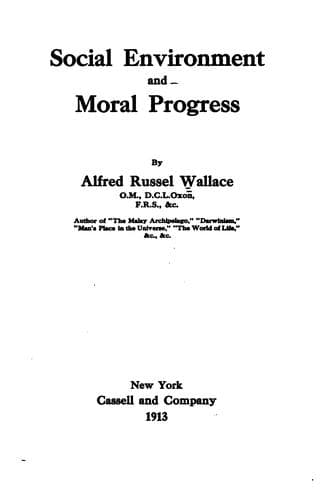
Social Environment and Moral ProgressWallace, Alfred Russel
Philosophy
Social Environment and Moral Progress
Wallace, Alfred Russel
Natural selection; Social ethics
If this were not so we should expect to find some isolated groups of
speechless man, and of this there is no example; but, on the contrary,
the very lowest of existing races are found to possess languages which
are often of extreme complexity in grammatical structure and in no way
suggestive of the primitive man-animal of which they are supposed to be
surviving relics. So long as we got our knowledge respecting them from
the low-class Europeans who captured them for slaves or shot them down
as wild beasts, we could not possibly acquire any real knowledge of
them as human beings. But now that we have more trustworthy accounts of
them by intelligent travellers or missionaries, we find ample evidence
that when by kindness and sympathy we penetrate to their inner nature,
we discover that they possess human qualities of the same kind as our
own. A few examples of what unprejudiced witnesses say of them will be
very instructive.
Darwin, after attending a meeting between Captain Fitzroy and the chief
of a small island near Tahiti to settle a question of compensation for
injury to an English ship, says: "I cannot sufficiently express our
surprise at the extreme good sense, the reasoning powers, moderation,
candour, and prompt resolution which were displayed on all sides."
Captain Cook himself, who saw them in their primitive condition,
speaks of the natives of the Friendly Isles as being "liberal, brave,
open and candid, without either suspicion or treachery, cruelty, or
revenge"; and a century later Admiral Erskine remarks that "they carry
their habits of cleanliness and decency to a higher point than the
most civilised nations"; while all the Polynesian races are kind and
attentive to the sick and aged, and unlimited hospitality is everywhere
practised by them.
Even the Australian aborigines, who are often said to be one of the
lowest of human races, are found to possess many good qualities by
those who know them best. Mr. Curr, who was for forty years protector
of the aborigines in Victoria, says:
"Socially, the black is polite, gay, fond of laughter, and
has much _bonhomie_ in his composition. . . . The natives are
very strict in obeying their laws and customs, even under
great temptation. The horror of marrying a woman within the
prohibited degrees of relationship, the extreme grief they
manifest at the death of children or relatives, and sometimes
even for white men, as illustrated by the native boy who
was the sole companion of the unfortunate Kennedy when he
was murdered, are sufficient to indicate that they possess
affections and a sense of right and wrong not very different
from our own."
Public-domain text, read in full here on John Shaqi.
Reviews
Reviews
No reviews yet
Be the first to share your thoughts on this work.
Join the Discussion
Join the discussion
Sign in to leave a comment or review.
Sign InorCreate an account