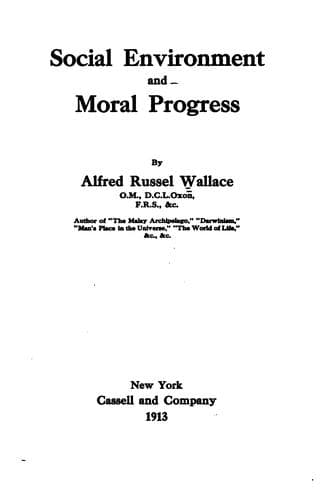
Social Environment and Moral Progress — John Shaqi
Social Environment and Moral ProgressWallace, Alfred Russel
Philosophy
Social Environment and Moral Progress
Wallace, Alfred Russel
Natural selection; Social ethics
This is another fact of Nature which requires to be kept in mind in
all discussions of the action of natural selection, yet it is often
altogether ignored by critics of the theory. As an illustrative fact,
a not uncommon European weed of the Cruciferæ family has been found
to produce about 700,000 seeds on a single plant, whence it can be
calculated that if every seed had room to grow for three successive
years their produce would cover a space of about 2,000 times as large
as the whole land surface of the globe. Some of the minute aquatic
forms of life which increase by division in a few hours would, if they
all had the means of living, in the same period occupy a space equal to
that of the entire solar system. Even the largest and slowest breeding
of all known mammals, i.e. the elephant, would, if allowed space to
live and breed freely for 750 years, result in no less than nineteen
million animals.
By far the larger part of the criticisms of Darwinism by popular
writers are due to their continually forgetting these two great natural
facts: enormous _variability_ about a _mean value_ of every part and
organ; and such ever-present powers of multiplication that, even in
the case of vertebrate animals, of those born every year only a small
proportion—one-tenth to one-hundredth or thereabouts—live over the
second year. If they all lived their numbers would go on continually
increasing, which we know is not the case. Hence arises what has been
termed "the struggle for existence," resulting in "the survival of the
fittest."
This "struggle for life" is either against the forces of inorganic or
those of organic nature. Among the former are storms, floods, intense
cold, long-continued droughts, or violent blizzards, all of which take
toll of the weaker or less wary individuals of each species—those that
are less adapted to survive such conditions. In judging how this would
act, we must always remember the enormous scale on which Nature works,
and that although now and then a few of the weaker individuals may live
and a few of the stronger be killed, yet when we deal with hundreds
of millions, of which eighty or ninety millions inevitably die every
year while about ten or twenty millions only survive, it is impossible
to believe that those which survive, not one year only but year after
year throughout the whole existence of each species, are not on the
average better adapted to the complex conditions of their environment
than those which succumb to it. It is a mere truism that the _fittest
survive_.
Public-domain text, read in full here on John Shaqi.
Reviews
Reviews
No reviews yet
Be the first to share your thoughts on this work.
Join the Discussion
Join the discussion
Sign in to leave a comment or review.
Sign InorCreate an account