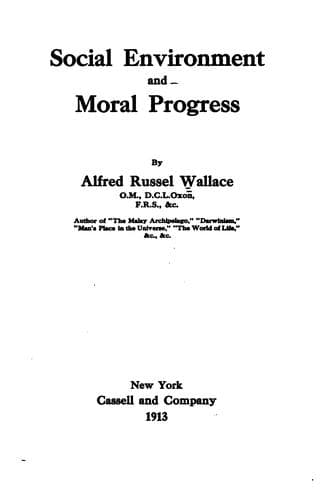
Social Environment and Moral ProgressWallace, Alfred Russel
Philosophy
Social Environment and Moral Progress
Wallace, Alfred Russel
Natural selection; Social ethics
Exactly the same thing occurs in the case of the organic environment,
to which each species must also be well adapted in order to live. The
two great essentials for animal existence are, to obtain abundant
food through successive years, and to be able to escape from their
various enemies. When food is scarce the strongest, or those who
can feed quickest and digest more rapidly, or those that can detect
food at greater distances or reach it more quickly, will have the
advantage. Enemies are escaped by strength, by swiftness, by acute
vision, by wariness, or by colours which conceal the various species
in their natural surroundings; and those which possess these or any
other advantages will in the long run survive. The weaker, the less
well-defended, and the smaller species often have special protection,
such as nocturnal habits, making burrows in the earth, possessing
poisonous stings or fangs, being covered with protective armour; while
great numbers are coloured or marked so as exactly to correspond with
their surroundings, and are thus concealed from their chief enemies.
_Natural Selection, or Survival of the Fittest_
It may be here noted that the term "Natural Selection," which has often
been misunderstood, was suggested to Darwin by the way in which almost
all our varieties of cultivated plants and domestic animals have been
obtained from wild forms continually improved for many generations. The
method is to breed large quantities, and always preserve or "select"
the best in each generation to be the parents of the next. This
method, carried on by hundreds of farmers, gardeners, dog, horse or
poultry breeders, and especially by pigeon-fanciers, has resulted in
all those useful, beautiful and even wonderful varieties of fruits,
vegetables and flowers, dray-horses and hunters, greyhounds, spaniels
and bull-dogs, cows which give large quantities of the richest milk,
and sheep with the greatest quantity and finest quality of wool. All
these were produced gradually for the special purposes of mankind; but
a similar result has been effected by Nature through rapid increase,
great variability, and continual destruction of all the individuals
less adapted to the conditions of their special environment, so that
only the strongest or the swiftest, the best-concealed or the most
wary, the best armed with teeth, horns, hoofs or claws, those who could
swim best, or those that protected each other by keeping in flocks or
herds—lived the longest and tended to improve still further the next
generation. "Survival of the fittest" was suggested by Herbert Spencer
as best describing exactly what happens, and it is a most useful
descriptive term which should always be kept in mind when discussing
or investigating the process by which the infinitely varied and
beautiful productions of Nature have been developed. There is really
not one single part or organ of any plant or animal that cannot have
Public-domain text, read in full here on John Shaqi.
Reviews
Reviews
No reviews yet
Be the first to share your thoughts on this work.
Join the Discussion
Join the discussion
Sign in to leave a comment or review.
Sign InorCreate an account