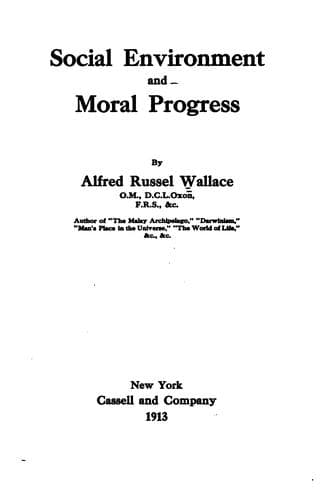
Social Environment and Moral ProgressWallace, Alfred Russel
Philosophy
Social Environment and Moral Progress
Wallace, Alfred Russel
Natural selection; Social ethics
But if we recognise the brain as the organ of the mind, and give due
weight to the complete distinctness and enormous superiority of the
mind of man as compared with that of all other mammals, we shall be
inclined to accept Owen's view as the most natural; and this becomes
almost certain when we realise the enormous effect his mind has
produced, in modifying and almost neutralising the action of that great
law of natural selection which has held supreme sway in every other
portion of the organic world.
We have seen in the preceding chapter how every form of organic life
during all the vast extent of geological time has been subject to the
law of natural selection, which has incessantly moulded their bodily
form and structure, external and internal, in strict adaptation to
the successive changes of the world around them; while that world was
itself hardly, if at all, modified by them. A few isolated cases—such
as the formation of islands by the coral-forming zoophytes, or the
damming of a few rivers by the rude though very remarkable labours of
the beaver—can hardly be considered as forming exceptions to this law.
But so soon as man appeared upon the earth, even in the earliest
periods at which we have any proofs of his existence, or in the
lowest state of barbarism in which we are now able to study him, we
find him able to use and act upon the forces of Nature, and to modify
his environment, both inorganic and organic, in ways which formed a
completely new departure in the entire organic world.
Among the very rudest of modern savages the wounded or the sick are
assisted, at least with food and shelter, and often in other ways,
so that they recover under circumstances that to most of the higher
animals would be fatal. Neither does less robust health or vigour, or
even the loss of a limb or of eyesight, necessarily entail death. The
less fit are therefore not eliminated as among all other animals; and
we behold, for the first time in the history of the world, the great
law of natural selection by the survival only of "the fittest" to some
extent neutralised.
But this is only the first and least important of the effects produced
by the superior faculties of man. In the whole animal world, as we have
seen, every species is preserved in harmony with the slowly changing
environment by modifications of its own organs or faculties, thus
gradually leading to the production of new species equally adapted to
the new environment as its ancestor was before the change occurred.
Public-domain text, read in full here on John Shaqi.
Reviews
Reviews
No reviews yet
Be the first to share your thoughts on this work.
Join the Discussion
Join the discussion
Sign in to leave a comment or review.
Sign InorCreate an account