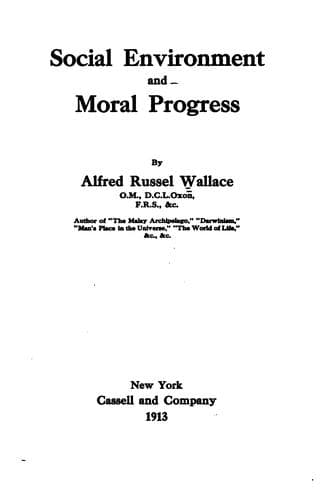
Social Environment and Moral ProgressWallace, Alfred Russel
Philosophy
Social Environment and Moral Progress
Wallace, Alfred Russel
Natural selection; Social ethics
But besides this lofty intellect, man is gifted with what we term a
moral sense: an insistent perception of justice and injustice, of right
and wrong, of order and beauty and truth, which as a whole constitute
his moral and æsthetic nature, the origin and progress of which I have
endeavoured to throw some light upon in the present volume. The long
course of human history leads us to the conclusion that this higher
nature of man arose at some far distant epoch, and though it has
developed in various directions, does not seem yet to have elevated the
whole race much above its earliest condition, at the time when, by the
influx of some portion of the spirit of the Deity, man became "a living
soul."
We will now consider some of the changes which this higher nature of
man has produced in the action of the laws of variation and natural
selection. These are very important, and are so little understood that
almost all popular writers on the subject of the future of mankind are
led into stating as scientific conclusions what are wholly opposed to
the actual teaching of evolution.
CHAPTER XIV
SELECTION AS MODIFIED BY MIND
The theory of natural selection as expounded by Darwin was so
completely successful in explaining the origin of the almost infinitely
varied forms of the organic world, step by step, during the long
succession of the geological ages, that it was naturally supposed to be
equally applicable to mankind. This was thought to be almost certain
when, in his later work, _The Descent of Man_, Darwin proved by a
series of converging facts and convincing arguments that the physical
structure of man was in all its parts and organs so extremely similar
to that of the anthropoid apes as to demonstrate the descent of both
from some common ancestor.
So close is this resemblance that every bone and muscle in the human
body has its counterpart in that of the apes, the only differences
being slight modifications in their shape and position; yet these
differences lead to external forms, attitudes, and modes of life so
divergent that we can hardly recognise the close affinity that really
exists. This affinity is so real and unmistakable that such a great
and conservative zoologist as the late Sir Richard Owen declared that
to discover and define any important differences between them was
the anatomist's difficulty. It was in the dimensions, the shape, and
the proportions of the brain that Owen found a sufficient amount of
distinctive characters to enable him to place Man in a separate order
of mammals—Bimana, or two-handed—while the remainder of the whole
monkey tribe—including the apes, baboons, monkeys, and lemurs—formed
the order Quadrumana, or four-handed animals. This classification has
been rejected by most modern biologists, who consider man to form a
distinct family only—Hominidæ—of the order Primates, which order
includes all four-handed animals as well as man.
Public-domain text, read in full here on John Shaqi.
Reviews
Reviews
No reviews yet
Be the first to share your thoughts on this work.
Join the Discussion
Join the discussion
Sign in to leave a comment or review.
Sign InorCreate an account