Social Environment and Moral Progress — John Shaqi
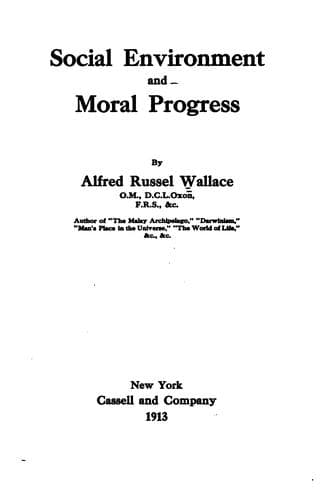
Social Environment and Moral ProgressWallace, Alfred Russel
Philosophy
Social Environment and Moral Progress
Wallace, Alfred Russel
Natural selection; Social ethics
In dealing with the great problems of organic development there is
probably no department in which so much error and misconception
prevails as on the nature and limitations of Heredity. These
misconceptions not only pervade most popular writings on the subject
of evolution, but even those of men of science and of specialists in
biology, and they are the more important and dangerous because their
promulgators are able to quote Herbert Spencer, and to a less extent
Darwin, as holding similar views.
The subject is of special importance here because it involves the
question of whether the effects of the environment, including education
and training, are in any degree transmitted from the individuals so
modified to their progeny—whether they are or are not cumulative.
It is, in fact, the much discussed and vitally important problem of
the Heredity of Acquired Characters. The effects of use and disuse,
another form of the same general phenomenon, were assumed by Lamarck to
be inherited, and a large portion of his theory of evolution rested on
this assumption; it seemed so probable, and was apparently supported by
so many facts, that Darwin, like most other naturalists at the time,
accepted it without any special inquiry, and when he worked out his
theory of Pangenesis in order to explain the main facts of heredity,
his suppositions were adapted to include such phenomena. Let us then
first explain what is meant by the "acquired characters" which it was
thought that a true theory of heredity must explain.
As a rule, the great majority of the peculiarities of any species
of animal or plant are constantly reproduced in its offspring. The
short tail of the wren, the much longer tail of the long-tailed tit,
the crest of the crested tit and of innumerable other birds, always
when full-grown exhibit the same characters as in their parents.
These are said to be _innate_ characters. In rare cases, however,
offspring are born which differ materially from their parents, as when
a white blackbird or a six-toed kitten appears, but these are equally
_innate_, and are often strongly inherited. All these are subject
to variation, and can therefore be modified by selection, whether
natural or artificial, and the effects of such selection in the case of
domestic animals is often enormous. Such are the pouters and tumblers
among pigeons, the bull-dog and the greyhound, the numerous breeds of
poultry, all of which are known to have been produced by artificial
selections of favourable variations extending over many centuries; and
the characters of these varieties are all strongly inherited.
Public-domain text, read in full here on John Shaqi.
Reviews
Reviews
No reviews yet
Be the first to share your thoughts on this work.
Join the Discussion
Join the discussion
Sign in to leave a comment or review.
Sign InorCreate an account