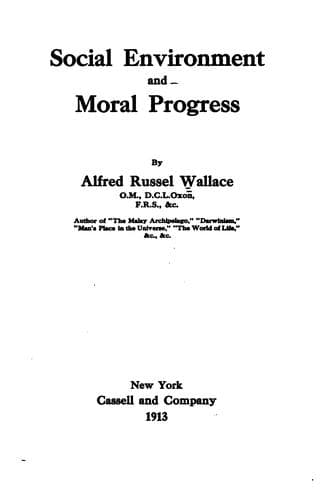
Social Environment and Moral ProgressWallace, Alfred Russel
Philosophy
Social Environment and Moral Progress
Wallace, Alfred Russel
Natural selection; Social ethics
Characters which are acquired during the life of the individual owing
to differences in the use of certain organs or of exposure to light,
heat, drought, wind, moisture, etc., are comparatively very slight,
and are liable to be so combined with _innate_ characters and with the
effects of natural or artificial selection, that it is exceedingly
difficult to ascertain, without such careful and long-continued
experiments as have not yet been made, whether they are in any degree
transmissible from parent to offspring, and therefore cumulative.
Almost every individual case of supposed inheritance of such
characters, when carefully examined, has been found to be explicable
in other ways; but there is a very large amount of _general_ evidence,
demonstrating that even if a certain small amount of such inheritance
exists, it can certainly not be a factor of any importance in the
process of organic evolution, all the factors of which must be
universally present because the process itself is universal. I will
therefore here limit myself to a short enumeration of a few of the
very numerous cases in which the continued use of an organ does not
strengthen or improve it, but often the reverse; and of others in which
it cannot be asserted that the action of the environment can have had
any part whatever in the continuous change or specialisation of the
part or organ. The number, size, form, position, and composition of
the teeth of all the mammalia are extremely varied, and throughout
the whole class afford the best characters to distinguish family and
generic groups; they are therefore of great value in determining the
affinities of extinct forms, because the jaws and teeth, especially
the latter, are most frequently preserved. But as the permanent teeth
are always fully formed while buried in the jawbones and covered by
the gums, it is quite certain that the special adaptation of the teeth
of each species to seize, crush, tear, or grind up its particular food
cannot possibly have been produced by the act of feeding, the effect
of which is almost always to grind away the teeth and render them less
serviceable. Such adaptation could not possibly have been produced
by _use_ alone, or any other direct action of the environment. Yet,
as the adaptation is clear, and often very remarkable, some eminent
palæontologists have declared it to be proved that the changes in
them were _produced_ by the changes in the environment, and that
they constitute very strong evidence of the "inheritance of acquired
characters"—a statement unsupported by any direct evidence.
The same objection applies to most of the special organs of sense.
The internal organ of hearing is a highly complex series of bones and
membranes, protected by the outer ear; but it cannot be even imagined
to have been gradually developed by the action of the air waves the
vibrations of which it conveys to the brain.
Public-domain text, read in full here on John Shaqi.
Reviews
Reviews
No reviews yet
Be the first to share your thoughts on this work.
Join the Discussion
Join the discussion
Sign in to leave a comment or review.
Sign InorCreate an account