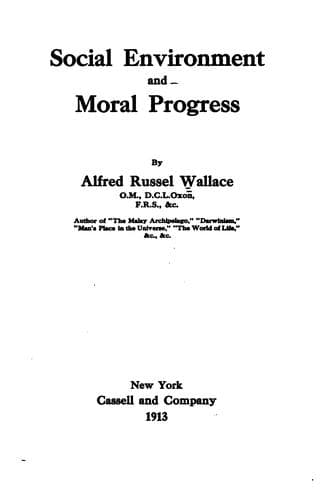
Social Environment and Moral Progress — John Shaqi
Social Environment and Moral ProgressWallace, Alfred Russel
Philosophy
Social Environment and Moral Progress
Wallace, Alfred Russel
Natural selection; Social ethics
The eye is a still more striking case, as too much use injures or even
destroys it; while specialities of vision, as long or short sight, are
undoubtedly _innate_, and usually persist throughout life.
So the wonderfully varied bills of birds cannot be conceived as having
been modified by use, and are, in fact, unchangeable when once formed.
Yet, as they vary largely in every species, they are readily modified,
so as to become adapted to new conditions by the "survival of the
fittest."
Equally impossible is it to connect any use or disuse, or environmental
action, in the production, the gradual development, or complete
adaptation to their conditions of life of the outer coverings of almost
all living things—the hair of mammalia, the feathers of birds, the
scales or horny skins or solid shields of reptiles, the solid shells
of molluscs, wonderfully ribbed or spined, whorled, or turreted, and
infinitely varied in surface colour and markings. Even more conclusive
are the facts presented by the vast hosts of the insect world, from
the massive armour of the ever-present beetle tribe, more varied in
form, structure, ornament, and colour than any other comparable group
of living things, to the widely different lepidoptera, equalling, or
perhaps surpassing, the whole class of birds in their marvellous grace
and beauty, yet all utterly beyond any possible direct action of the
environment or of use and disuse in their development, and their close
adaptation to that environment.
Organic nature is indisputably one and indivisible. It has been
developed throughout by means of the fundamental _forces_ of life,
of growth and reproduction, and the equally fundamental _laws_ of
variation, heredity, and enormous increase, resulting in a perpetual
adaptation in form, structure, colour, and habits to the slowly
changing environment. These forces and laws are _universal_ in their
action; they are demonstrably adequate to the production of the whole
of the phenomena we are now discussing. We see, then, that over by
far the greater part of the whole world of life any modification
of external structure, form, or colouring during the life of the
individual is impossible; while in the remainder its action, if it
exists at all, is of very limited range. No adequate _proof_ of the
inheritance of the slight changes thus caused has ever yet been given,
and it is therefore wholly unnecessary and illogical to assume its
existence and to adduce it as having any part in the ever-active and
universal process of evolution.
Public-domain text, read in full here on John Shaqi.
Reviews
Reviews
No reviews yet
Be the first to share your thoughts on this work.
Join the Discussion
Join the discussion
Sign in to leave a comment or review.
Sign InorCreate an account