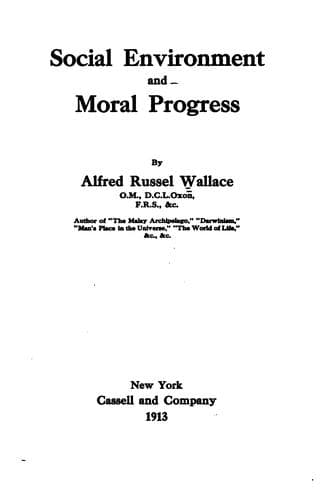
Social Environment and Moral ProgressWallace, Alfred Russel
Philosophy
Social Environment and Moral Progress
Wallace, Alfred Russel
Natural selection; Social ethics
If we glance through the past history of mankind we see an almost
unbroken succession of aggression and combat between the various races,
nations, and tribes. We can dimly see that this continual struggle did
lead to a rather severe process of selection, as in the lower animal
world. It can hardly be doubted that as a result of these struggles the
strongest physically, the most ingenious in the use of weapons, and
the best organised for war did survive, and that the weaker and lower
were either exterminated or kept as slaves by the conquerors. This
leads to alternation of success and failure. We see great conquerors
and great material civilisations as a result of their accumulations
of wealth and of slaves. Then, for a time, luxury and the arts
flourished, and with them came rulers who encouraged degradation and
vice at home, supported by more and more remote conquests. Then new
conquerors arose, often lower in civilisation—barbarians, as they were
termed—but higher in the simple domestic virtues and a more natural
life of productive labour. These again, or some portions of them, rose
to luxury and civilisation, to lives of gross sensuality and the most
cruel despotism, till outraged humanity raised up new conquerors to go
over again the old terrible routine.
The periods of culmination of these old civilisations, founded always
on conquest, massacre, and slavery, are marked out for us by the ruins
of great cities, temples, and palaces, often of wonderful grandeur, and
with indications of arts, science, and literature which still excite
our admiration in Egypt and India, Greece and Rome; and thence through
the Middle Ages down to our own time. But the inhumanities and horrors
of these periods are inconceivable. A gloomy picture of them is given
in that powerful book, _The Martyrdom of Man_, by Winwood Reade; and
they are summarised in Burns' fine lines:
"Man's inhumanity to man
Makes countless thousands mourn."
Think of the horrors of war in the perpetual wars of those days before
the "Red Cross" service did anything to alleviate them. Think of the
old castles, many of which had besides the dungeons a salaried torturer
and executioner. Think of the systematic tortures of the centuries, of
the witchcraft mania and of the Inquisition. Think of the burnings in
Smithfield and in every great city of Europe. Think of
"Truth for ever on the scaffold,
Wrong for ever on the throne."
Freedom of speech, even of thought, were everywhere crimes: how,
then, did the love of truth survive as an ideal of to-day? To escape
these horrors, the gentle, the good, the learned, and the peaceful
had to seek refuge in monasteries and nunneries, while by means of
the celibacy of the clergy the Church, as Galton tells us, "by a
policy singularly unwise and suicidal, brutalised the breed of our
forefathers."
Public-domain text, read in full here on John Shaqi.
Reviews
Reviews
No reviews yet
Be the first to share your thoughts on this work.
Join the Discussion
Join the discussion
Sign in to leave a comment or review.
Sign InorCreate an account