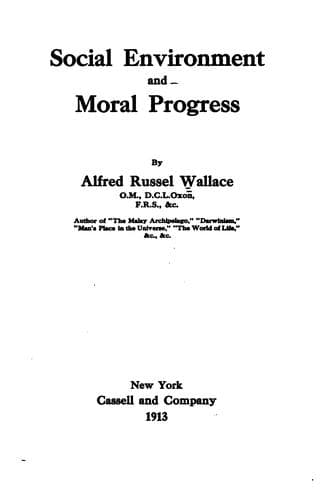
Social Environment and Moral Progress — John Shaqi
Social Environment and Moral ProgressWallace, Alfred Russel
Philosophy
Social Environment and Moral Progress
Wallace, Alfred Russel
Natural selection; Social ethics
Here was the actual _education_ of the world as man rose from barbarism
to civilisation, and it was accompanied by a certain amount of
retrograde selection by the cruel punishments, confinement in dungeons,
or torture and death of those who opposed the rulers, and by the
survival of the worst tools of the lords and tyrants. Ought we not to
be thankful that such education and custom, the varied influences of
such an environment, _were not_ hereditary? And is not the fact that
the whole world has _not_ become utterly degraded, and that anything
good remains in our cruelly oppressed human nature, an overwhelming
proof that such influences _are not_ hereditary?
When we remember that many of these degrading laws and customs,
oppressions, and punishments have extended down to our own times; that
the terrible slave-trade and the equally terrible slavery have only
been abolished within the memory of many of us; and that the system
of wage-slavery, the distinction of classes, the gross inequality of
the law, the overwork of our labouring millions, the immoral luxury
and idleness of our upper-class thousands, while far more thousands
die annually of want of the bare necessaries of life; that millions
have their lives shortened by easily preventable causes, while other
millions pass their whole lives in continuous and almost inhuman labour
in order to provide means for the enjoyments and pernicious luxuries of
the rich—we must be amazed at the fact that there is nevertheless so
much real goodness, real humanity, among us as certainly exists, in
spite of all the degrading influences that I have been compelled here
to enumerate.
To myself, there seems only one explanation of the very remarkable and
almost incredible result just stated. It is, that the Divine nature
in us—that portion of our higher nature which raises us above the
brutes, and the influx of which makes us men—cannot be lost, cannot
even be permanently deteriorated by conditions however adverse, by
training however senseless and bad. It ever remains in us, the central
and essential portion of our _human_ nature, ready to respond to every
favourable opportunity that arises, to grasp and hold firm every
fragment of high thought or noble action that has been brought to its
notice, to oppose even to the death every falsehood in teaching, every
tyranny in action. The ethics of Plato and of the great moralists of
the Ciceronian epoch, together with those of Jesus and of His disciples
and followers, kept alive the sacred flame of pure humanity, and their
preservation constitutes perhaps the greatest service the monastic
system rendered to the human race. This service is finely expressed by
an almost unknown poet, J. H. Dell, in the prefatory to his volume,
_The Dawning Grey_. Never has our indebtedness to the classical writers
been more powerfully insisted on than in the following lines:—
Public-domain text, read in full here on John Shaqi.
Reviews
Reviews
No reviews yet
Be the first to share your thoughts on this work.
Join the Discussion
Join the discussion
Sign in to leave a comment or review.
Sign InorCreate an account