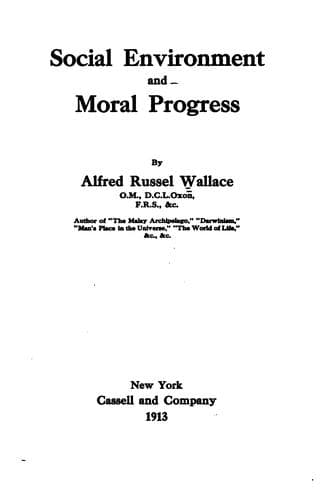
Social Environment and Moral ProgressWallace, Alfred Russel
Philosophy
Social Environment and Moral Progress
Wallace, Alfred Russel
Natural selection; Social ethics
"'Have thy wishes,' answered Yama; 'thy good lord shall live again,
He shall live to be a father, and your children, too, shall reign;
For a woman's troth endureth longer than the fleeting breath,
And a woman's love abideth higher than the doom of death.'"
And when at the end of the epic, the kings and warriors welcome each
other in the spirit world, we find the following noble conception of
the qualities and actions which give them a place there:
"These and other mighty warriors, in the earthly battle slain,
By their valour and their virtue walk the bright ethereal plain!
They have lost their mortal bodies, crossed the radiant gate of
heaven,
For to win celestial mansions unto mortals it is given!
Let them strive by kindly action, gentle speech, endurance long,
Brighter life and holier future unto sons of men belong!"
Mr. Dutt informs us that he has not only reproduced, as nearly as
possible, the metre of the original, but has aimed at giving us a
literal translation. No one can read his beautiful rendering without
feeling that the people it describes were our intellectual and moral
equals.
The wonderful collection of hymns known as the Vedas is a vast system
of religious teaching as pure and lofty as those of the finest portions
of the Hebrew scriptures. A few examples from the translation by Sir
Monier Monier-Williams will show that its various writers were fully
our equals in their conceptions of the universe, and of the Deity,
expressed in the finest poetic language. The following is a portion of
a hymn to "The Investing Sky":
"The mighty Varuna, who rules above, looks down
Upon these worlds, his kingdom, as if close at hand.
When men imagine they do aught by stealth, he knows it.
No one can stand or walk, or softly glide along
Or hide in dark recess, or lurk in secret cell
But Varuna detects him and his movements spies.
* * * *
This boundless earth is his,
His the vast sky, whose depth no mortal e'er can fathom.
Both oceans find a place within his body, yet
In the small pool he lies contained; whoe'er should flee
Far, far beyond the sky would not escape the grasp
Of Varuna, the king. His messengers descend
Countless from his abode—for ever traversing
This world, and scanning with a thousand eyes its inmates.
Whate'er exists within this earth, and all within the sky,
Yea, all that is beyond King Varuna perceives.
May thy destroying snares cast sevenfold round the wicked,
Entangle liars, but the truthful spare, O King."
The following passage from a "Hymn to Death," shows a perfect
confidence in that persistence of the human personality after death,
which is still a matter of doubt and discussion to-day:
Public-domain text, read in full here on John Shaqi.
Reviews
Reviews
No reviews yet
Be the first to share your thoughts on this work.
Join the Discussion
Join the discussion
Sign in to leave a comment or review.
Sign InorCreate an account