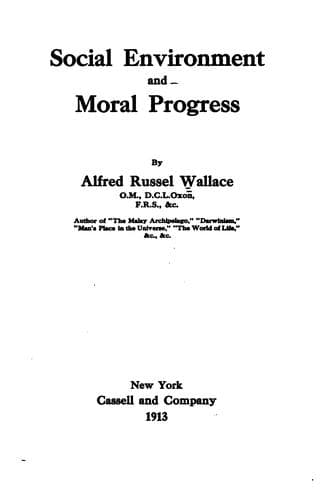
Social Environment and Moral ProgressWallace, Alfred Russel
Philosophy
Social Environment and Moral Progress
Wallace, Alfred Russel
Natural selection; Social ethics
"To Yama, mighty king, he gifts and homage paid.
He was the first of men that died, the first to brave
Death's rapid rushing stream, the first to point the road
To heaven, and welcome others to that bright abode.
No power can rob us of the home thus won by thee.
O king, we come; the born must die, must tread the path
That thou hast trod—the path by which each race of men,
In long succession, and our fathers too, have passed.
Soul of the dead! depart; fear not to take the road—
The ancient road—by which thy ancestors have gone;
Ascend to meet the god—to meet thy happy fathers,
Who dwell in bliss with him.
Return unto thy home, O soul! Thy sin and shame
Leave thou behind on earth; assume a shining form—
Thy ancient shape—refined and from all taint set free."
In this we find many of the essential teachings of the most advanced
religious thinkers—the immediate entrance to a higher life, the
recognition of friends, the persistence of the human form, and the
shining raiment, typical of the loss of earthly taint.
But besides these special deities, we find also the recognition of the
one supreme God, as in the following hymn:
"What god shall we adore with sacrifice?
Him let us praise, the golden child that rose
In the beginning, who was born the Lord—
The one sole lord of all that is—who made
The earth, and formed the sky, who giveth life,
Who giveth strength, whose bidding gods revere,
Whose hiding place is immortality,
Whose shadow, death; who by his might is king
Of all the breathing, sleeping, waking world—
Who governs men and beasts; whose majesty
These snowy hills, this ocean with its rivers,
Declare; of whom these spreading regions form
The arms by which the firmament is strong,
Earth firmly planted, and the highest heavens
Supported, and the clouds that fill the air
Distributed and measured out; to whom
Both earth and heaven, established by his will,
Look up with trembling mind; in whom revealed
The rising sun shines forth above the world."
If we make allowance for the very limited knowledge of Nature at this
early period, we must admit that the mind which conceived and expressed
in appropriate language, such ideas as are everywhere apparent in
these Vedic hymns, could not have been in any way inferior to those of
the best of our religious teachers and poets—to our Miltons and our
Tennysons.
CHAPTER IV
PERMANENCE OF HIGH INTELLECT
Public-domain text, read in full here on John Shaqi.
Reviews
Reviews
No reviews yet
Be the first to share your thoughts on this work.
Join the Discussion
Join the discussion
Sign in to leave a comment or review.
Sign InorCreate an account