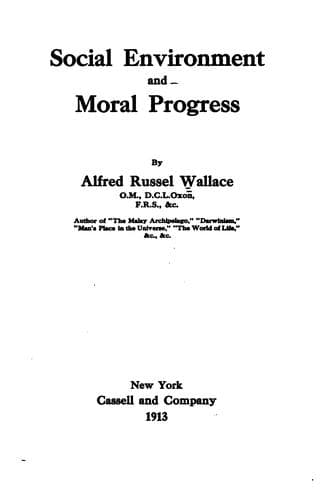
Social Environment and Moral ProgressWallace, Alfred Russel
Philosophy
Social Environment and Moral Progress
Wallace, Alfred Russel
Natural selection; Social ethics
In my recent works, _Man's Place in the Universe_ and _The World of
Life_, the conclusion was forced upon me, that the scheme of the
development of the universe of stars and nebulæ with which we are
acquainted, and especially of our sun and solar system, was such as to
furnish the exact conditions on our earth, and there only, which should
allow of the origin and evolution of the organic world culminating in
man. Yet further, that the conditions should be such as to produce the
maximum of diversity both of inorganic and organic products useful
to man, and such as would aid in the development of the greatest
possible diversity of character and especially of his higher mental
and moral nature. What I have here termed the Divine influx, which
at some definite epoch in his evolution at once raised man above the
rest of the animals, creating as it were a new being with a continuous
spiritual existence in a world or worlds where eternal progress was
possible for him. To prepare him for this progress with ever-increasing
diversity, faculties of enormous range were required, and these needed
development in every direction which earthly conditions rendered
possible. In order that this extreme diversity of character should
be brought about, a great space of time, as measured by successive
generations, was necessary, though utterly insignificant as compared
with the preceding duration of organic life on the earth, and still
more insignificant as compared with the spirit-life to succeed it. It
is for this purpose, perhaps, that languages become so rapidly diverse
and mutually unintelligible after a moderate period of isolation,
binding together small or moderate communities in distinct tribes or
nations, which each develop in their own way under the influence of
special physical surroundings and originate peculiarities of habits,
customs, and modes of thought. Antagonisms soon arise between adjacent
tribes, leading each to protect itself against others by means of
chiefs and some quasi-military combinations. This requires organisation
and foresight, and after a time the most powerful conquers the weaker,
they intermingle, and still greater diversity arises. By this constant
struggle the less advanced suffer most, and the race as a whole takes a
step forward in the march of civilisation.
Public-domain text, read in full here on John Shaqi.
Reviews
Reviews
No reviews yet
Be the first to share your thoughts on this work.
Join the Discussion
Join the discussion
Sign in to leave a comment or review.
Sign InorCreate an account