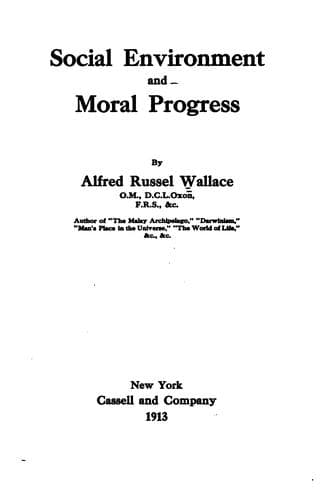
Social Environment and Moral ProgressWallace, Alfred Russel
Philosophy
Social Environment and Moral Progress
Wallace, Alfred Russel
Natural selection; Social ethics
"Hear ye not the measured footfalls echoing solemn and sublime,
From the groves of Academus down the avenues of Time;
See'st thou not the giant figures of the Sages of the Past,
Through the darken'd long perspective on the living foreground cast;
Feel'st thou not the thrilling rhythm of the grand old Grecian line,
Pulsing to the march of Progress, cadencing her hymn divine,
All the forces of the present by the subtle sparks controlled,
Of the quickening Grecian fire, of the mighty Lights of old.
"Through the dark and desolation of the centuries between,
Still 'The Porch's' glories glimmer, still 'The Garden's' wreaths
are green.
Still the Zeno, still the Plato, still the Pyrrho points the page,
Still the Philip fears the pebble—still Melitus dreads the Sage,
Still the Dionysius trembles at the stylus of the age.
Still the dauntless ranks of Freedom kindle to Tyrtæus' song;
Still they bear aloft the symbol—bear the glorious torch
along."[118:A]
[118:A] See Note on page 124.
If the Christian Church had done nothing for us but preserve in its
monasteries and abbeys the finest examples of classic literature
that have come down to us, and given us those glories of Gothic
architecture which seem to express in stone the grandeur and sublimity,
the peacefulness and the beauty of a pure religion, it would,
notwithstanding its many defects, its cruelty and oppression, its
opposition to the study of nature and to freedom of thought, have fully
justified its existence as helping us to realise whatever more advanced
and purer civilisation the immediate future may have in store for us.
_Some Light on the Problem of Evil_
Before passing on to another branch of my subject I feel it necessary
to make a few suggestions in reply to the objection that will certainly
and very properly be made, as to why, if our higher human nature
is in its essence Divine, it has suffered such long and terrible
eclipses—why has the lower so often and for so long prevailed over
the higher? This is, of course, one of the many forms of the old
problem of the origin of evil, which is no doubt insoluble by us. But
as it is a fairly well-defined and limited portion of that problem it
may be possible to obtain some idea of a possible solution, and as such
an one has occurred to myself during the composition of the present
volume, I will give it as briefly as possible in the hope that it may
interest some of my readers.
Public-domain text, read in full here on John Shaqi.
Reviews
Reviews
No reviews yet
Be the first to share your thoughts on this work.
Join the Discussion
Join the discussion
Sign in to leave a comment or review.
Sign InorCreate an account