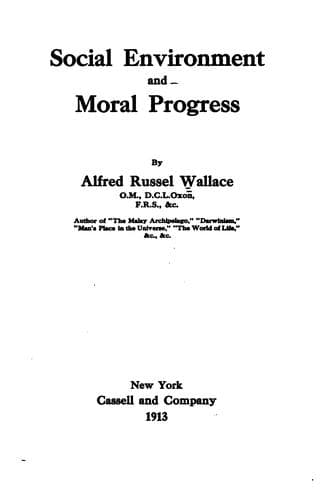
Social Environment and Moral ProgressWallace, Alfred Russel
Philosophy
Social Environment and Moral Progress
Wallace, Alfred Russel
Natural selection; Social ethics
The Great Pyramid and the two smaller ones near it, forming the
pyramids of Gizeh, are placed on a small rocky plateau near the apex
of the delta of the Nile. The largest of these is situated so that its
northern face rises from the very edge of this plateau. The reason of
this seems to have been that the builders wished to place it as nearly
as possible on the 30th parallel of latitude. It is really about a
mile and a third south of that parallel, and it is shown that such an
error is a small one for that early period, and would matter but very
little for the purpose required. The next feature is that it is truly
oriented; that is, the four sides run north and south, east and west.
It is also a true square, the four sides being of equal length, and the
four corners are on a truly level plane.
The first thing the builders had to do was to get a true meridian
line, and they could have done this in two ways—by observations of
the sun or of the pole star, the latter being much the more accurate,
though more laborious and costly. At the time the pyramid was built
the pole star was Alpha Draconis, which was farther from the pole than
our pole star and revolved around the true pole in a circle of 7° 24′
in diameter. In order to observe the direction of this star at its
lowest point, the builders excavated in the solid rock a tunnel about
4 feet in diameter, so as to keep this star visible each day at the
lowest point of its circuit. This tunnel extended 350 feet through the
rock to a point nearly under the centre of the pyramid, where, by a
small vertical boring, a plumb-line could have been dropped so as to
obtain the exact line of the meridian on the surface, and afterwards
on each successive step of the pyramid as it was built up. While the
building went on the sloping tunnel was continued backwards to its
northern face; and a tunnel ascending to the south was formed of the
same size and making the same angle with the horizon. This had puzzled
all previous explorers of the pyramid till Mr. Proctor showed that, by
stopping up the downward passage at the angle and filling the hollow
with water the pole star could be observed by reflexion and thus give
the exact direction of the meridian on the upper surface of the pyramid
with extreme accuracy, as it was built up slowly year by year.
Public-domain text, read in full here on John Shaqi.
Reviews
Reviews
No reviews yet
Be the first to share your thoughts on this work.
Join the Discussion
Join the discussion
Sign in to leave a comment or review.
Sign InorCreate an account