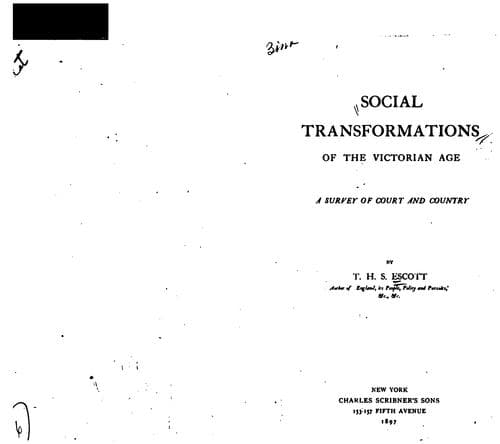
Social Transformations of the Victorian Age: A Survey of Court and CountryEscott, T. H. S. (Thomas Hay Sweet)
History
Social Transformations of the Victorian Age: A Survey of Court and Country
Escott, T. H. S. (Thomas Hay Sweet)
Great Britain -- Civilization -- 19th century; Great Britain -- Social life and customs -- 19th century
Thus, statistics show that more than half the human beings born die from
accidents or ailments before reaching marriageable age. Of those who
actually reach that age, an uncertain, but considerable proportion fail to
find mates; the men perhaps because they are over fastidious or selfish;
the women possibly because they lack attractions of dower or person. With
many more the course of true love runs crooked; the desired partner not
being attainable, a solitary life is led. In other cases, the fear of not
being able to maintain a conventional position acts as a deterrent. Then
there is the considerable percentage of cases where legitimate
opportunities of marriage are denied. Thus Colonial frontier men in
solitary wilds have few opportunities of courtship or matrimony. Soldiers
constantly changing their station; or sailors with a brevet wife in every
port, are not usually marrying men, or the founders of numerous families.
Of those who marry, many have no children, some have only one; others have
sickly children who die. On the assumption that everyone in the world
married, each pair must have two children to keep up the population.
Hence the critics of the Malthusian theory have calculated that, striking
out of their count those who cannot or will not marry, and those who,
marrying, are childless; merely to maintain the population without
increasing it, every married couple ought to produce a family of six.
Though according to the Malthusians themselves this sufficiently liberal
allowance of progeny might be reached without any calamitous consequences,
practical acquaintance with the contingencies of domestic life shows that
this quantum will not often be reached. If in any part of the world there
existed conditions favourable to marriage and to fecundity, it was in
Australia, shortly after the earliest gold discoveries, but when many
immense fortunes had been made in farming; here there was work for all,
wages were high, living cheap, cultivable, but uncultivated land abounded;
finally there were no catastrophic checks from earthquake, pestilence or
famine to the multiplication of human beings; if, therefore, the
Malthusian doctrine could anywhere be verified, surely it would be here.
Notwithstanding all these inducements to marriage and the propagation of
the species, the actual rate of population increase was 2 per cent. a
year.
Public-domain text, read in full here on John Shaqi.
Reviews
Reviews
No reviews yet
Be the first to share your thoughts on this work.
Elsewhere in the archive
Join the Discussion
Join the discussion
Sign in to leave a comment or review.
Sign InorCreate an account