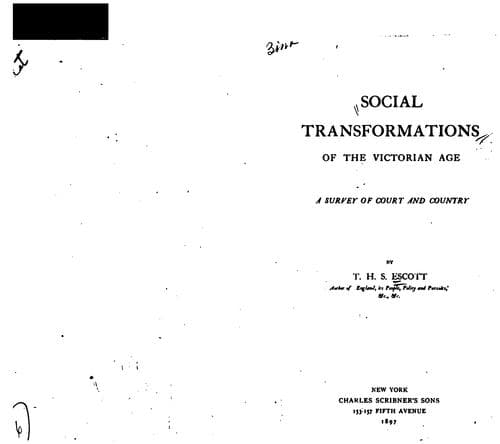
Social Transformations of the Victorian Age: A Survey of Court and CountryEscott, T. H. S. (Thomas Hay Sweet)
History
Social Transformations of the Victorian Age: A Survey of Court and Country
Escott, T. H. S. (Thomas Hay Sweet)
Great Britain -- Civilization -- 19th century; Great Britain -- Social life and customs -- 19th century
Hence it may perhaps be inferred that this represents the normal rate.
That falls far short of the geometrical rate which the Malthusians would
have us expect. The physiological truth, as expounded by experts in these
matters would seem to be that in proportion as subsistence is more
abundant and of a better kind, life more regular and artificial, fertility
decreases. Scientific physicists point as proof of this statement to the
fact that wild animals when domesticated or in good condition are less
prolific than in their normally savage and poor state. So it is with women
in the western wilds of Ireland, or in the Scotch Highlands. As their food
and clothing are scarce and coarse, their maternity increases. The
inference from the facts now cited clearly is that whatever the terms of
the Malthusian proposition may mean, their significance does not warrant
the conclusions that ardent Malthusians have at all times drawn from them.
But it has been asserted that famine and plague are the Divinely appointed
checks to the growth of population; thus showing some external restraint
upon the multiplication of the race to be necessary to prevent population
outstripping subsistence. The most familiar proofs offered of such an
assertion are the periodical famines in India, especially that in the
province of Orissa, and the Irish famine from the potato failure in 1846.
On these proofs the following remarks suggest themselves. In the case of
Orissa, numbers had nothing to do with the famine or consequent mortality;
the people died because the heat of the sun untempered by rain literally
scorched the food supply out of existence; if there had been only as many
hundreds as there were millions, the same calamitous result, though on a
numerically smaller scale, would have ensued; a province of Central India
was decimated because the food did not exist. The famine therefore was
real.
Public-domain text, read in full here on John Shaqi.
Reviews
Reviews
No reviews yet
Be the first to share your thoughts on this work.
Elsewhere in the archive
Join the Discussion
Join the discussion
Sign in to leave a comment or review.
Sign InorCreate an account