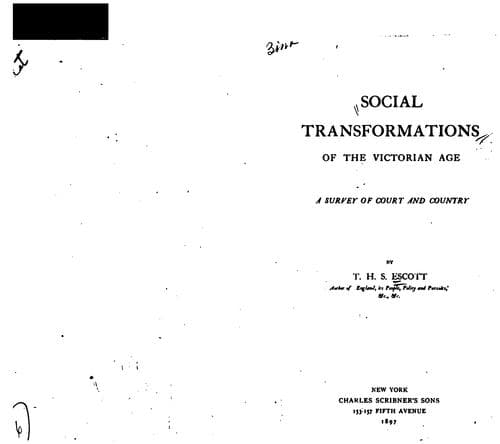
Social Transformations of the Victorian Age: A Survey of Court and CountryEscott, T. H. S. (Thomas Hay Sweet)
History
Social Transformations of the Victorian Age: A Survey of Court and Country
Escott, T. H. S. (Thomas Hay Sweet)
Great Britain -- Civilization -- 19th century; Great Britain -- Social life and customs -- 19th century
In the case of Ireland, no famine at the close of the first decade of the
Queen's reign existed in the same sense that it had done in Orissa; the
potato crop alone failed; corn, dairy produce, food products generally
were plentiful; corn in fact was being exported from Ireland while the
Irish themselves were perishing from starvation. The calamity therefore
was less the stoppage of supplies by Providence as a check on population
than a pecuniary failure. Nor was it a visitation as regards which man
could plead exemption from responsibility. The potato rot did not come
upon the Irish peasantry in a day or in a week. The disease had appeared
in Eastern Europe so early as 1844 and 1843; it was scientifically certain
that eventually it would reach Ireland. When, after due warning it
attacked the plots of miserable soil reclaimed by peasant industry from
hillside and bog, the destruction of the staple of native food wrought by
it was gradual. Weeks and months were required to complete the process of
rotting. Nothing was done. The people died not from the unkindness of
nature, but from the neglect of man. Had the prudential restraints of the
Malthusians limited the numbers to half the actual total, the agrarian
policy which was responsible for the diet of potatoes instead of corn
would have resulted in the same poverty and, therefore, in the same
death.[48]
One is not here concerned with the abstract truth of the theory of
population enounced by Malthus, but with its applicability to, or its
instructiveness in the case of, the England of Queen Victoria. What then
are the facts of population here to be dealt with? The multiplication of
the inhabitants of this country is known never to have been so rapid as
during the century which opens with the French Revolution in 1793, and
which witnesses at its close the sixtieth anniversary of Her Majesty's
accession. Earlier periods of augmentation may therefore be omitted. A
hundred years ago, Dr Price, maintaining population actually to have
decreased, spoke of its decline as a great danger. Cobbett and other more
accurate observers, or less incautious generalizers, in opposition to Dr
Price, established circumstantially the fact of an increase; but the
possibility of a contrary view being taken is as suggestive as it now
seems remarkable.
Public-domain text, read in full here on John Shaqi.
Reviews
Reviews
No reviews yet
Be the first to share your thoughts on this work.
Elsewhere in the archive
Join the Discussion
Join the discussion
Sign in to leave a comment or review.
Sign InorCreate an account