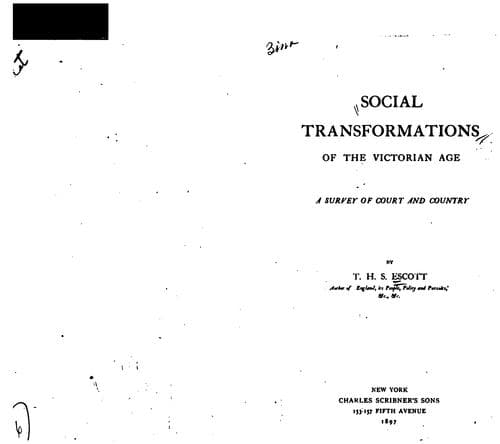
Social Transformations of the Victorian Age: A Survey of Court and CountryEscott, T. H. S. (Thomas Hay Sweet)
History
Social Transformations of the Victorian Age: A Survey of Court and Country
Escott, T. H. S. (Thomas Hay Sweet)
Great Britain -- Civilization -- 19th century; Great Britain -- Social life and customs -- 19th century
Mr Thorold Rogers has been guided by his study of prices to the conclusion
that the standard of comfort in living began to rise among us from the
Reformation of the sixteenth century progressively onwards; and that even
during the eighteenth century the masses were enjoying a golden age.
Between 1750 and 1800;--the period during which the factory system began
to be known, and the problems of population and production were both
closely discussed,--no fear of population getting ahead of subsistence
suggested itself. Similarly during the Corn Law agitation 1840-6, the
increase of production from English soil, notwithstanding the
economico-agrarian law of diminishing return was proved to have outgrown
the population. Later and more detailed statistics show that since 1831
population with us has increased 30 per cent., capital 100 per cent.,
purchasing power 600 per cent. During the last half century the average
price of corn has been falling. Our demand for foreign corn has increased
and is increasing. This evidence fortified by the income-tax returns,
forbids the notion that during the last two centuries population in
England has outstripped the means of its support. The conclusion is
therefore irresistible that the natural tendencies to increase of
inhabitants, whatever the occult possibilities may be, practically are
counteracted by motives invisible and undefinable, perhaps, but not less
potent. As a writer in _Macmillan's Magazine_[49] points out, population
generally increases up to the relative limit set by the power of procuring
subsistence at any given time and place. The absolute limit as is shrewdly
remarked, could only be reached when the highest skill and organization
have extracted the last possible morsel of food from the earth; that
experience has not yet been reached. So far from population always getting
ahead of subsistence, its increase is by no means invariably as rapid as
the development of the food supply. Both between 1560 and 1760; again
between 1830 and 1880, this seems to have been the case in England.
Public-domain text, read in full here on John Shaqi.
Reviews
Reviews
No reviews yet
Be the first to share your thoughts on this work.
Elsewhere in the archive
Join the Discussion
Join the discussion
Sign in to leave a comment or review.
Sign InorCreate an account