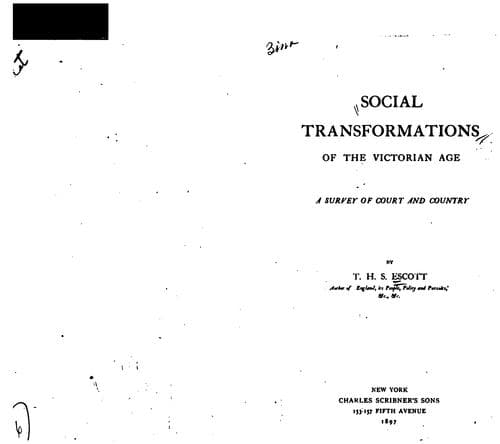
Social Transformations of the Victorian Age: A Survey of Court and CountryEscott, T. H. S. (Thomas Hay Sweet)
History
Social Transformations of the Victorian Age: A Survey of Court and Country
Escott, T. H. S. (Thomas Hay Sweet)
Great Britain -- Civilization -- 19th century; Great Britain -- Social life and customs -- 19th century
During many years, as each decennial census has appeared, timid
sociologists may well have felt misgivings whether England could continue
to support her ever multiplying millions. The fears of science have not
been verified by the facts of experience; thus exactly a quarter of a
century since the census return of 1871 seemed to leave no escape from the
conclusion, that population had already all but overtaken the means of
subsistence, or that unless our numbers were at once arrested, it must in
a very short time do so. Since 1871 we have added 7 millions to our
population, the equivalent, that is, of 1,200,000 families and the same
number of working men. Instead of the pressure on subsistence being
greater, or the average condition of our people being worse, the exact
opposite has occurred. In comparison with the state of things two decades
since, the masses among us are to-day better housed, better clothed,
better shod, better fed, better educated. There is, as in an earlier
chapter was shown, a steady decrease of pauperism; the number of those who
with their dependents of all kinds live on the result of their
investments, is growing constantly. Whether it be due to the reduction in
the cost of conveyance, to the opening up of fresh fields of supply, or to
the appreciation of gold, the fall in prices of the chief articles of
consumption, corn, sugar, tea, cotton, timber, is a visible and a great
benefit to the country.
The fact that the increase between 1881 and 1891 fell short by about a
quarter of a million of that which signalized the preceding ten years has
been demonstrated by statistical experts of scientific authority not to
indicate pressure on means of subsistence, but to be explicable by the
stationariness of the population in many rural districts as well perhaps
as by the disinclination, reflected from French and American precedent, of
Englishwomen indefinitely to fulfil the functions of maternity.
During the period now spoken of, with the exception of mining, the great
staple industries of the United Kingdom have none of them increased, while
agriculture has decreased. It may, therefore, well seem problematical how
the 1,200,000 fresh heads of families have found a livelihood for
themselves and their belongings.
Public-domain text, read in full here on John Shaqi.
Reviews
Reviews
No reviews yet
Be the first to share your thoughts on this work.
Elsewhere in the archive
Join the Discussion
Join the discussion
Sign in to leave a comment or review.
Sign InorCreate an account