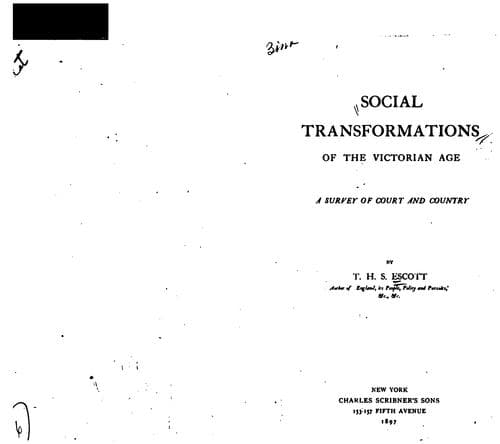
Social Transformations of the Victorian Age: A Survey of Court and CountryEscott, T. H. S. (Thomas Hay Sweet)
History
Social Transformations of the Victorian Age: A Survey of Court and Country
Escott, T. H. S. (Thomas Hay Sweet)
Great Britain -- Civilization -- 19th century; Great Britain -- Social life and customs -- 19th century
This arrangement immensely increases the authority of the democratic
favourite of the moment. It is less favourable to the prestige or
usefulness of the Chamber as containing the collective wisdom of the
nation. The aptitude for business talk that shall be to the point in
Committee has not, when the House has a mind to it, declined. The great
speeches, no sooner delivered than they constitute national text-books,
are less frequent than the display of excellence in debate. Afraid of
boring the Assembly, dreading the imputation of mere rhetoric, the Member
who has something to say usually prefers delivering it to his constituents
at his periodical reunion with them, or upon some other extra
parliamentary occasion. The terse diction and urbane gravity of manner of
Sir Charles Dilke made him, during his Foreign Under-Secretaryship, a
parliamentary model. Such oratorical efforts as he sometimes made, were
reserved for the meetings with his electors. The clever young politician,
being on his promotion, speaks when he can that he may give his future
chief a taste of his quality. Popular meetings therefore, and the
periodical press have detracted from the House of Commons as a school of
eloquence, or as a national educator. On the other hand the House of Lords
has no constituencies in the background. Its time is less preoccupied. It
is to-day far more representative of the English people than was the House
of Commons a few years before the Queen's accession. It does indeed
chiefly consist now of men whose station and whose antecedents are not
very dissimilar from those of the House of Commons before that Chamber had
been thrice Reformed. Hence some of those debates, especially on foreign
policy, or grave points of constitutional procedure that used to mark
epochs in the Elective Chamber are now almost confined to the Hereditary
House.
Outbursts of periodical petulance against the Peers will doubtless
continue. Such Radicals as may be left in England to-day are at heart far
more tolerant of a second Chamber, composed as that at Westminster is,
than were the 'root and branch' men not merely of Cromwell's day, but of
half a century ago. Something therefore may perhaps be said on behalf of
the opinion that any movement which may be successful against the House of
Lords is likely to affect the House of Commons as well.[54]
CHAPTER XIX
CROWN, COUNTRY AND COMMONS
Public-domain text, read in full here on John Shaqi.
Reviews
Reviews
No reviews yet
Be the first to share your thoughts on this work.
Elsewhere in the archive
Join the Discussion
Join the discussion
Sign in to leave a comment or review.
Sign InorCreate an account