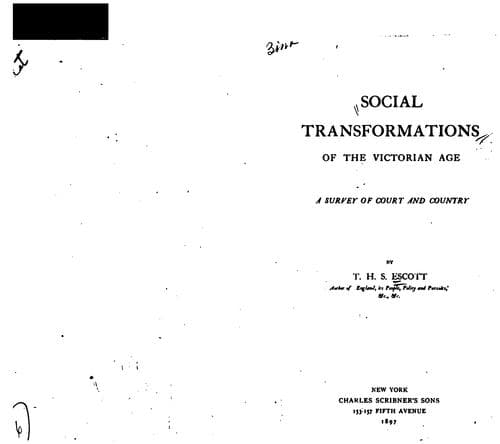
Social Transformations of the Victorian Age: A Survey of Court and CountryEscott, T. H. S. (Thomas Hay Sweet)
History
Social Transformations of the Victorian Age: A Survey of Court and Country
Escott, T. H. S. (Thomas Hay Sweet)
Great Britain -- Civilization -- 19th century; Great Britain -- Social life and customs -- 19th century
Comparative youth not the only point of difference between the House
of Commons to-day and formerly. Its reflection of social
characteristics of the time shown in the disappearance of the old
County Member extinct in the country as well as in Parliament.
Modifications in _personnel_ of the Liberal party since the great
fortunes made in trade and since the first Reform Act; also in that of
the Conservatives. Mr Gladstone's opinion and experience on this
subject. The obstacles in the way of oratorical efforts or success in
the House of Commons, have increased under new conditions. Rivals to
House as representative of national feelings. The press, the House of
Lords and local debating societies.
The average age of its members is not the only respect in which, during
the Queen's reign, the House of Commons has been gradually transformed. If
the country squire of the old school of Mr Henley has disappeared from it,
that is because he is now as unknown in his own county as in Pall Mall.
The social composition of the Whig, or Liberal, party was finally and
entirely altered about the period of the first Reform Bill. The change had
indeed been going forward from the earlier epoch when the middle class of
commerce began to be, as from the days of the Edwards it was tending to
become, the greatest power in the country. The replacement of the old
Whig, with his territorial associations, by the new Liberal, like Mr
Cobden, was only the last stage in the development of self-government in
England. In truth, however, the kind of progress now spoken of was not
limited to any single political connection. The Nestorian experience of Mr
Gladstone testifies it to have been not less noticeable among Tories than
among Whigs. There were not, he thinks, in 1835 five members of the
Conservative party owing their seats to commercial or industrial
influences. The change which has come about in the composition of the
party since then is 'simply marvellous.'[55] The specific legislation that
has surrounded the English Crown by a democracy, is the extension of the
lodger franchise to boroughs in 1867, to counties in 1884, and the
cheapening of elections by the Corrupt Practices Bill of Sir Henry James
in 1883. Notwithstanding these advances, the blend between authority and
freedom has never been more fortunately conspicuous nor more wisely active
in this country than since the period of its self-government began. Before
1870 it used to be said that the Pope, shorn of his temporal power, would
exercise a prerogative not weaker, but stronger than when he was sole lord
of Rome. Whether that prediction has, or has not been fulfilled, the
influence that a constitutional Sovereign can exercise in the United
Kingdom has increased rather than diminished since the days of absolute
monarchy were over. Whatever in the way of political initiative the
Sovereign has surrendered has in the department of social ascendancy and
Public-domain text, read in full here on John Shaqi.
Reviews
Reviews
No reviews yet
Be the first to share your thoughts on this work.
Elsewhere in the archive
Join the Discussion
Join the discussion
Sign in to leave a comment or review.
Sign InorCreate an account