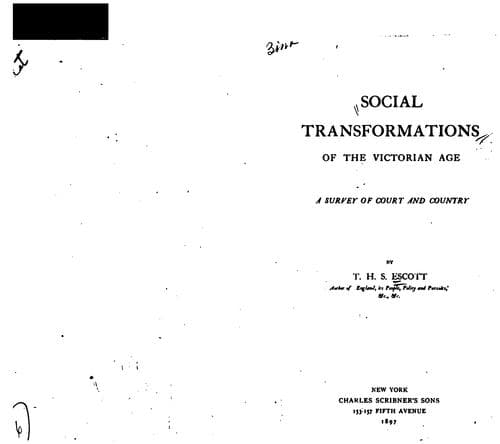
Social Transformations of the Victorian Age: A Survey of Court and CountryEscott, T. H. S. (Thomas Hay Sweet)
History
Social Transformations of the Victorian Age: A Survey of Court and Country
Escott, T. H. S. (Thomas Hay Sweet)
Great Britain -- Civilization -- 19th century; Great Britain -- Social life and customs -- 19th century
proud to accord, like a horse that knows, and that takes a pleasure in,
its rider. Therefore the House expects from those who address it something
more than the bald, business talk of the Board room; an aptitude for
clothing sound original reasons in diction which shall be without
pretentiousness, but that shall not lack felicity and point always, and
epigram sometimes. If these conditions be forthcoming; if the Chamber be
in a good humour; if it be neither too long nor too soon since it lunched
nor too near the hour when it dines; then the elective legislators will
perhaps for a short time give their ear to one who rises at the right
moment and in favour of whom they are predisposed. The conditions are
obviously severe. It is therefore not to be wondered at that candidates
for oratorical honours at St Stephen's tend steadily to diminish.
There is another kind of rivalry to which of late years the House of
Commons has been exposed, which may excite a smile, but which is in its
way a reality to be reckoned with. This is not that of the provincial
platform, of the public meeting room, or of the debating society in its
older development. These latter have always, among the lower middle
classes, fulfilled a function like that of the University Unions among the
classes somewhat better to do. Coger's Hall was the school of discussion
in which the late Charles Bradlaugh acquired great power of direct and
incisive utterance as well as a perfect control over his temper. London
and all the great provincial towns have as many of these places as ancient
Rome possessed of gladiatorial schools. A really new growth of the last
quarter of the nineteenth century is the local Houses of Commons. These
sprung up in and for every quarter or suburb of London, and in many
provincial districts as well. They are still known, and sometimes much in
vogue. They are not of course recognized by the legislature. Nor, as in
the case of the municipal bodies which we have already seen at work, is
their machinery controlled by the Local Government Board. A seat in them
has been known to be as much an object of rivalry among an increasing
class, as a place on the green leather benches of Westminster. The member
for Kennington or Lavender Hill in the south of London, for Westbourne
Grove or Shepherd's Bush in the west, for Haverstock Hill in the north,
may even be as considerable a personage with his immediate friends in the
district as the member for Westminster in the Imperial Parliament. The
leader in the Hampstead House of Commons, or the Chancellor of the
Exchequer in that which meets on Richmond Hill is not certain that he
would change his place with his titular equivalents at St Stephen's. These
are considerations that may explain why the House of Commons, whose
supremacy was unchallenged under a Peel, a Stanley, a Palmerston, a
Disraeli, a Gladstone, is regarded no longer with awe, sometimes with the
familiarity that breeds contempt.
Public-domain text, read in full here on John Shaqi.
Reviews
Reviews
No reviews yet
Be the first to share your thoughts on this work.
Elsewhere in the archive
Join the Discussion
Join the discussion
Sign in to leave a comment or review.
Sign InorCreate an account