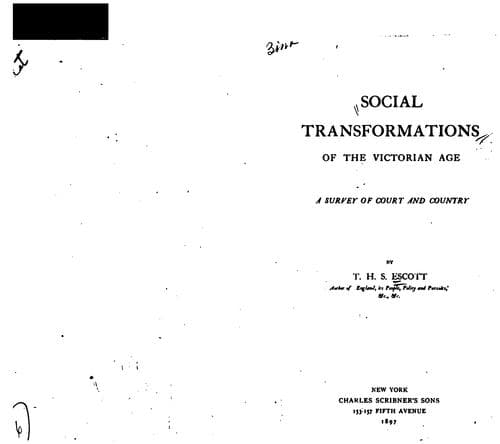
Social Transformations of the Victorian Age: A Survey of Court and CountryEscott, T. H. S. (Thomas Hay Sweet)
History
Social Transformations of the Victorian Age: A Survey of Court and Country
Escott, T. H. S. (Thomas Hay Sweet)
Great Britain -- Civilization -- 19th century; Great Britain -- Social life and customs -- 19th century
As yet this diminution of parliamentary prestige, if such there really be,
is indicated only by a floating sentiment. It finds expression chiefly in
social chatter or in newspaper flippancies. Nor in the present decade of
the Victorian epoch are there many positive signs of our representative
system being superseded by the controlling will of an individual autocrat
for whom the late Mr Froude thought the time was steadily approaching. The
same remark might with equal truth probably be made of every part in our
national polity. It is certainly true of the House of Lords not less than
of the monarchy. The position practically occupied by the Crown to-day, is
that which the Prince Consort many years ago marked out for it. Some of
these functions he was himself able to assist the Queen in discharging. To
him there seemed to devolve upon the monarchy duties analogous to those
discharged by the permanent officials in the great departments of State.
Amid the vicissitudes of party, the rise and fall of Ministers, the
changes of popular opinion, the Crown was in his judgment the one
guarantee for continuity in policy, domestic not less than foreign. The
occupant of the Throne took, as Ministers of State, those whom
parliamentary majorities and public opinion indicated. The Sovereign
however had other functions than merely to register and sanction the wish
of subjects and the decisions of Commons. Chief among these, as every
other page of Sir Theodore Martin's book during the Peelite and
Palmerstonian periods clearly shows, was to judge of the quarters whence a
stable Administration could be formed; whether, in fact, Lord John
Russell, Lord Palmerston, or Lord Derby, in a balanced state of
parliamentary feeling, had the best chance of carrying on the Queen's
government to the welfare of the realm and the confidence of its
representatives. The most familiar aspects of the political and
parliamentary situation have ceased to be now what in the Prince
Consort's day they habitually were. The doctrine that Ministers are the
free choice of the Sovereign was never propounded absolutely by the
husband of the Queen. The doctrine was rather assumed by him in the
interests of the national convenience than expressed in any terms defining
the Royal prerogative. The slow process of absorption of the Peelites into
the Liberal ranks; the lifelong rivalry of Lord John Russell and Lord
Palmerston produced, during much of the Prince Consort's time, a condition
of unstable equilibrium in party organization, which in these later days
of popular mandates, general elections which are plebiscites and of
overwhelming majorities which amount to commissions of the democracy, it
is not easy to realize.
Public-domain text, read in full here on John Shaqi.
Reviews
Reviews
No reviews yet
Be the first to share your thoughts on this work.
Elsewhere in the archive
Join the Discussion
Join the discussion
Sign in to leave a comment or review.
Sign InorCreate an account