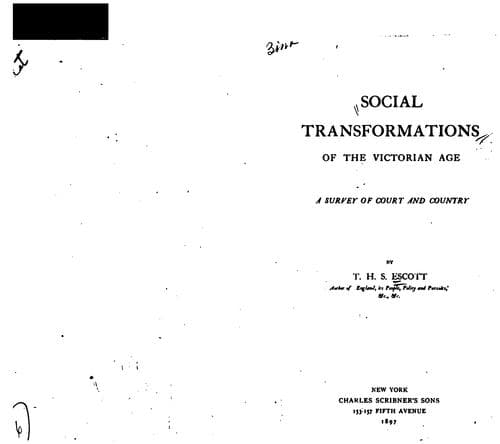
Social Transformations of the Victorian Age: A Survey of Court and CountryEscott, T. H. S. (Thomas Hay Sweet)
History
Social Transformations of the Victorian Age: A Survey of Court and Country
Escott, T. H. S. (Thomas Hay Sweet)
Great Britain -- Civilization -- 19th century; Great Britain -- Social life and customs -- 19th century
Some there were who thought that the Liberal disruption of 1886 might
reproduce in English politics the precarious and fluctuating relations of
parties and statesmen that seemed between 1852 and 1865 to have become
permanent. Had that forecast been fulfilled, the Sovereign to-day might be
confronted with personal responsibilities of Ministerial selection which
would have recalled the duty devolved upon her during earlier portions of
her reign. Nothing of the kind has happened. The event of ten years ago
has resulted not in party instability, but in fresh fixity of tenure to
the political conglomerate that the constituencies have as yet shown no
wish to dismiss. Of course in time the same conditions as of old must
recur. The national organization of which Liberals as well as
Conservatives are constituent parts, will at some day or other upon
issues perhaps now unsuspected resolve themselves into their elements.
Ancient lines of demarcation will again declare themselves. A cycle of
government by groups may yet be opened.[58] People and Parliament may
still wait for the Royal choice to close an interval of confusion and of
doubt. In whatever form this reversion to an older order may present
itself, whatever the exact contingencies in store, the occupant of the
Throne as has been shown above cannot divest himself of the right,
therefore of the duty, of giving a casting vote when his officers of State
hesitate, as Mr Disraeli did in 1868, as to the exact moment when the
appeal to the constituences most advantageously can be made.
CHAPTER XX
ROYALTY AS A SOCIAL FORCE
The general power and usefulness of the English Crown strengthened,
and not weakened, by the constitutional transfer of political power to
Parliament and Ministers. The national aims of Queen Victoria and
Queen Elizabeth contrasted. Possibility of the Sovereign more
correctly than Parliament or Ministers interpreting indications of
national will. What happened under Queen Anne may conceivably occur
under some of her successors. The facts concerning the monarchy as
they are to-day. Posthumous recognition of the soundness of the Prince
Consort's views on the sphere of Royal duties, and the legitimate
field of the Crown's activities. His influence still a living force.
Court offices, and reforms attributable to him. The present Prince of
Wales exactly follows his father's example.
Public-domain text, read in full here on John Shaqi.
Reviews
Reviews
No reviews yet
Be the first to share your thoughts on this work.
Elsewhere in the archive
Join the Discussion
Join the discussion
Sign in to leave a comment or review.
Sign InorCreate an account