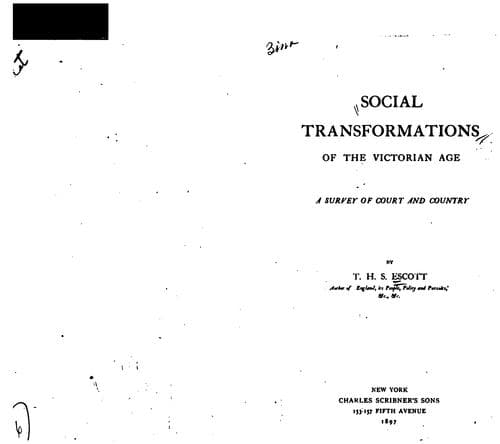
Social Transformations of the Victorian Age: A Survey of Court and CountryEscott, T. H. S. (Thomas Hay Sweet)
History
Social Transformations of the Victorian Age: A Survey of Court and Country
Escott, T. H. S. (Thomas Hay Sweet)
Great Britain -- Civilization -- 19th century; Great Britain -- Social life and customs -- 19th century
Whatever of power may have been resigned by the Crown in the way of
political authority has since that resignation abundantly been recompensed
to it in the direction of social authority. The latest predecessor of her
own sex upon the English Throne correctly interpreted as against
periodical parliamentary majorities the loyalty of the nation to the
Anglican Establishment; then a synonym for High Church Toryism. The Legion
Memorial,[59] probably drawn up by Daniel Defoe, marks the lowest point of
unpopularity ever reached by the House of Commons. No one would venture
to say that a repetition of such an experience, however unlikely, is more
impossible under Queen Victoria, than at one time it might have seemed
under Queen Anne. The chances of a revival, with the national consent, of
the personal prerogative of the Sovereign in Church and State affairs,
though far from being inconceivable towards this changeful close of the
century are too problematical for serious calculation. Like Queen
Elizabeth, Queen Victoria, from her accession to the Throne, proposed to
herself as an ideal the affection of her people. The Tudor Sovereign,
however, amid all her desire for the personal attachment of her subjects,
bated no jot of her queenly dignity or hereditary pretensions. The
Hanoverian Sovereign who blends the lines of Tudor and Stuart in her own
person has always kept before her an object equally distinct, but far more
congenial to the graciousness of her sex. An Elizabeth never willingly
allowed the tenderness of the woman to eclipse the majesty of the Queen. A
Victoria has never, consciously or unconsciously, veiled the motherhood of
her people by the pomp of their ruler. The stages by which the conception
of English sovereignty that is to-day a national possession has attained
its present completeness, must now be examined. From her sex, and the
circumstances of her life, it has long been inevitable that some of the
social functions (in the sense in which that epithet is now used) of the
Sovereign should be discharged vicariously by other members of the
reigning House. Whether it be Prince and Heir Apparent, or Royal Duke
makes no difference to the present argument. The idea of the monarchy
actually operative among us to-day whether in its constitutional,
ceremonial, or social attributes is at all points stamped with the impress
of one systematizing and controlling mind.
Public-domain text, read in full here on John Shaqi.
Reviews
Reviews
No reviews yet
Be the first to share your thoughts on this work.
Elsewhere in the archive
Join the Discussion
Join the discussion
Sign in to leave a comment or review.
Sign InorCreate an account