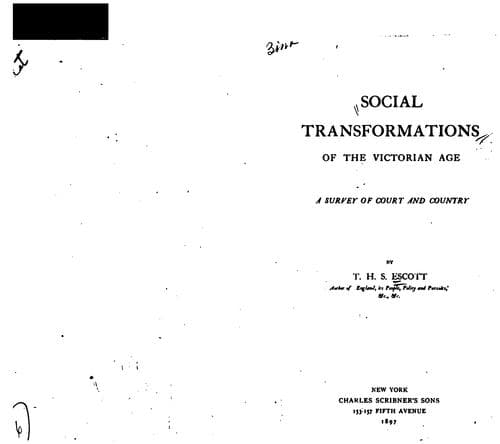
Social Transformations of the Victorian Age: A Survey of Court and CountryEscott, T. H. S. (Thomas Hay Sweet)
History
Social Transformations of the Victorian Age: A Survey of Court and Country
Escott, T. H. S. (Thomas Hay Sweet)
Great Britain -- Civilization -- 19th century; Great Britain -- Social life and customs -- 19th century
That beneficent intelligence is in human shape no longer with us. Never
was there man whose works and projects have lived after him more
vigorously and usefully than the Prince Consort. To the generation that
has grown up since his death, the notions which he was the first to apply
to the Court usages of England, the ends to which, before him, no member
of the reigning family had employed the opportunities of the Crown are so
familiar; they seem so essential a part of the Kingly office; a Sovereign
or a Prince not discharging such duties is so inconceivable by nineteenth
century Britons, as to make many persons forget the existence of a time
when this portion of the Royal duties was disliked as a novelty, or
resented as an impertinence. It is not too much to say that the Victorian
England of these later years is that which, more than any other uncrowned
individual, the Prince Consort was the instrument of making it. He it was
who set the example of that many-sided, almost ubiquitous, assistance in
the extra-political occasions of English life which to-day are more
conspicuously associated with the representatives of the kingly principle
in England than the attendance at levees, or the opening of drawing rooms.
Nor must it ever be forgotten that the future husband of the Queen from
earliest youth, not less than her future Majesty herself, was trained with
an eye to the possibilities of the alliance and the duties that the
accident of birth might have in store. Writing in July 1821 to the Duchess
of Kent, the Dowager Duchess of Coburg says of the young Prince Albert:
'The little fellow is the pendant to the pretty cousin' (the Princess
Victoria).[60] Prince Leopold, who married the Princess Charlotte
naturally supplied the first link of cousinly association between his
nephew and niece. Other and more highly placed suitors were not of course
wanting. But it needed no great experience in the tactics of matrimonial
diplomacy accurately to conjecture the relations tolerably certain to be
developed between the second son of Duke Ernest of Saxe-Coburg-Saafeld and
the niece of William IV., heiress to the English Crown. It is well that
the august contingencies of the future should sometimes have been forecast
by those around the young Prince. Otherwise it might have proved more
difficult than subsequently it did prove, or perhaps have been found
impracticable to rear on the foundations of boyish education the fabric of
a genuine knowledge of English character, of English life and
institutions. Hence it was that the disappointment of Lord Melbourne's
over sanguine anticipations of the reception of the Prince by his adopted
countrymen was borne with the equanimity which he showed on hearing that
the proposed allowance of £50,000 a year, though not, as Colonel Sibthorp
suggested, reduced to £21,000, was to be fixed at £30,000. All he
regretted was that his ability to help artists, men of learning and of
Public-domain text, read in full here on John Shaqi.
Reviews
Reviews
No reviews yet
Be the first to share your thoughts on this work.
Elsewhere in the archive
Join the Discussion
Join the discussion
Sign in to leave a comment or review.
Sign InorCreate an account