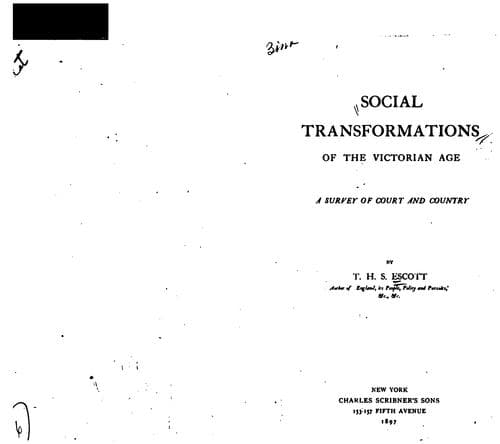
Social Transformations of the Victorian Age: A Survey of Court and CountryEscott, T. H. S. (Thomas Hay Sweet)
History
Social Transformations of the Victorian Age: A Survey of Court and Country
Escott, T. H. S. (Thomas Hay Sweet)
Great Britain -- Civilization -- 19th century; Great Britain -- Social life and customs -- 19th century
science would be necessarily more restricted than he had hoped.[61]
Naturally the economy of the Court system was the first to feel the
reforming influence of the man who afterwards helped profoundly to modify
the whole system of English life at large. The first opposition was
encountered at the hands not of an Englishman, but of a fellow
countrywoman of his own, the Baroness de Lehzen, who, from being the young
Queen's governess, had become the head of her household. The abuses and
extravagance of the Royal establishment shocked, as they well might have
done, the frugal Prince. Nor was it only that the money expended yielded
no proportionate return of comfort and convenience. The very rudiments of
domestic supervision were found to be wanting. Windsor Castle was only one
degree better than Buckingham Palace. Those employed about the Royal
dwelling not only had themselves free ingress into the living rooms of the
family, a nondescript gathering of camp followers, loafers and errand boys
also contrived to pass in and out unchallenged. On one occasion a boy was
found, with no felonious intent, to have passed the night under a sofa in
a parlour next to the Queen's bedroom. The lad had no wish to have done
so. He was simply shut in, unperceived by those whose business it was to
lock up.[62] In this work the Prince Consort was confronted by the
opposition which the reformer of inveterate abuses never fails in any
department of life to encounter. The administration of the Palace
household below stairs in a less wantonly wasteful manner was held to
threaten the dignity of those about the Throne. A check upon weekly bills
in the basement was suspected of veiling a sinister design on the
constitution of Church and State. Sir Robert Peel in 1841 had dwelt on the
difficulty of domestic reforms in the Palace. In 1843 he acknowledged the
economy and efficiency with which the Queen's Household was now conducted.
The Minister was vilified in the cheap weekly papers as a joint
conspirator with those foreigners who christened their treason by the fair
names of retrenchment and order. He was even attacked in clubs and drawing
rooms by fine and fashionable people for being ready to compromise the
dignity and disturb the equilibrium of the British Crown. The chief point
of the Prince Consort's Court improvements was concentration of
responsible power upon a single individual in the place of its confused
distribution among mutually conflicting understrappers. In this task he
was aided by Baron Stockmar who had all the national aptitude of the
German for the details small and great in the domestic routine of palaces
and princes. The ultimate result of these operations was to invest a
Master of the Household identical in all respects with that functionary as
he exists to-day, with supreme jurisdiction over the domestic arrangements
of the Sovereign, able directly to communicate with the departments for
executing the different repairs.
Public-domain text, read in full here on John Shaqi.
Reviews
Reviews
No reviews yet
Be the first to share your thoughts on this work.
Elsewhere in the archive
Join the Discussion
Join the discussion
Sign in to leave a comment or review.
Sign InorCreate an account