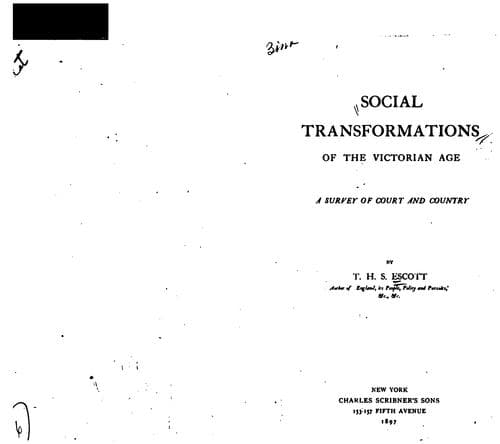
Social Transformations of the Victorian Age: A Survey of Court and CountryEscott, T. H. S. (Thomas Hay Sweet)
History
Social Transformations of the Victorian Age: A Survey of Court and Country
Escott, T. H. S. (Thomas Hay Sweet)
Great Britain -- Civilization -- 19th century; Great Britain -- Social life and customs -- 19th century
Nor of all the army reformers who have lived and worked since the Prince's
day, is there one who has failed to testify his indebtedness to the
suggestions of the husband of the Queen. In his many talks on this subject
with the military advisers of the Government of the day, the Prince often
anticipated those improvements in the administration of the land forces of
the Crown which since his time have been carried out. As the Prince
Consort correctly inferred from the character of the English people as
well as from the pace of official movements in England, must be the case,
the progressive changes in the English army have been effected piecemeal
by slow or minute instalments. The method pursued here has differed not
less from that followed in the reorganization of Continental armies than
the composition of the army of England differs from that of the great
fighting machines of the rest of Europe. In Prussia, after the defeat of
Jena (1806); in Austria after France had triumphed for Italy on the field
of Solferino (1859) the organic reconstruction of armies was possible.
Nothing of the same sort has taken place in England. Nothing, as the
Prince Consort perceived, of this kind could be effected here, unless
under the conscription. That system the Queen's husband once observed was
not likely to be established in England without a revolution.
The changes which the Prince suggested in able memoranda to successive
Ministers, which indeed he partly foresaw as coming, may in their general
results briefly be glanced at now. The mere enumeration of the military
resources of the country on the Queen's accession and on the eve of the
sixtieth anniversary of that event needs few words to deepen the contrast.
In 1837 the total military strength (regular army) of the country was
101,000. Sixty years later these figures were 147,105.[68] In 1837 India
was garrisoned by the Company's army of 26,500. In 1897 the Indian
military strength was 74,299 British, 129,963 Native. The increase has
been therefore, nearly threefold. In 1837 the Irish troops were 20,000. In
1897 these were between 26,000 and 27,000. As against the 26,000 troops in
the Channel Islands and Great Britain in 1837, there were in 1897, 81,516.
The entire strength of the horsed-field artillery in the accession year
was 72 guns--all at home. On New Year's Day 1897 the artillery total of
all kinds at home and abroad was 219 batteries or companies. In 1837 the
Horse Artillery batteries were armed with 12-pounder howitzers, and
6-pounder guns; the Field batteries had 9-pounder guns, 24-pounder
howitzers. The infantry still used the old flint 'Brown Bess,' which in
the cant phrase of the time was warranted at 200 yards to miss a haystack.
The Rifle regiments used the Brunswick rifle which at 400 yards, according
to Lord Wolseley, could not implicitly be trusted. To-day, the equipping
of our troops with the latest weapons of precision which contemporary
Public-domain text, read in full here on John Shaqi.
Reviews
Reviews
No reviews yet
Be the first to share your thoughts on this work.
Elsewhere in the archive
Join the Discussion
Join the discussion
Sign in to leave a comment or review.
Sign InorCreate an account