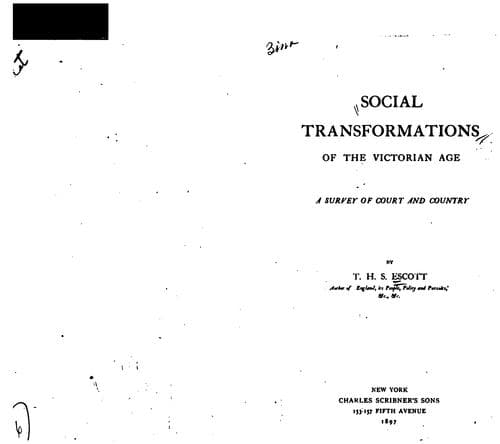
Social Transformations of the Victorian Age: A Survey of Court and CountryEscott, T. H. S. (Thomas Hay Sweet)
History
Social Transformations of the Victorian Age: A Survey of Court and Country
Escott, T. H. S. (Thomas Hay Sweet)
Great Britain -- Civilization -- 19th century; Great Britain -- Social life and customs -- 19th century
science designs is of itself a great department of English artificership.
Jealousy of the army is as much a bequest from Puritan times to the House
of Commons, as jealousy of the Church. Under the two first Georges, bitter
and tedious debates on the maintenance of the Hanoverian soldiers were of
constant recurrence. As a consequence, the standing troops which in the
Napoleonic wars had been 220,000 men were gradually reduced till in three
years after the peace (1818), they were only 80,000 strong.
Not without much pressure had Parliament during the earliest infancy of
the Colonies provided a handful of soldiers for the protection of settlers
in the lands beyond the sea as well as for the maintenance of civil order
at home. It was the paucity of the numbers available for his orders which
rendered the Duke of Wellington's scheme of London defence against
Chartist attack so memorable a piece of strategy. Even the influence and
popularity of this great soldier only secured the existence of a small
army at home on condition that it did not flaunt itself ostentatiously
before the civilian population. To keep up any fighting strength at all
the non-combatant portion of the army was reduced to an ineffective
minimum. Without exception, regiments were weak in men and horses. The
four chief company depôts at home consisted of veterans waiting their
discharge, of invalids, and of ineffective, or imperfectly effective,
recruits.
Sometimes, as during the Canadian and Jamaica troubles in the earlier
years of the reign, additional troops were required for the Colonies.
These were composed of volunteers from other regiments and of casual
recruits. The _personnel_ of our army may be inferred from the Duke of
Wellington's oft-quoted remark that the man who enlisted was the worst and
most drunken inhabitant of the village. This was the scum of the earth
which under officers trained on the playing fields of Eton, the Duke had
led to victory in his Peninsular campaigns and in the Low Countries
against the consummate veterans of the French army. To win the affection
of his men; to make them feel that their commander was also their friend,
and of the same flesh and blood as themselves never occurred to the great
Duke. His latter-day successor, Lord Wolseley, on the Christmas day of
1896, visited the Wellington Barracks to taste the pudding and test the
comforts of the men. That was not the great Duke's way.
Public-domain text, read in full here on John Shaqi.
Reviews
Reviews
No reviews yet
Be the first to share your thoughts on this work.
Elsewhere in the archive
Join the Discussion
Join the discussion
Sign in to leave a comment or review.
Sign InorCreate an account