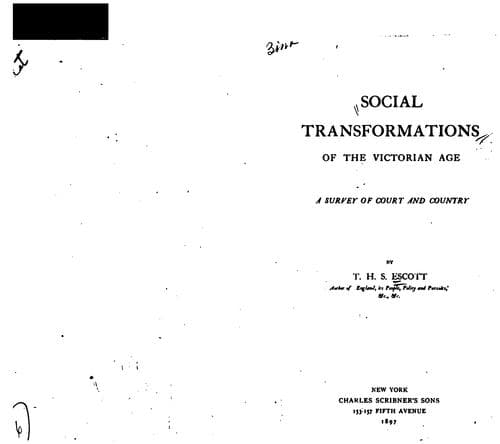
Social Transformations of the Victorian Age: A Survey of Court and CountryEscott, T. H. S. (Thomas Hay Sweet)
History
Social Transformations of the Victorian Age: A Survey of Court and Country
Escott, T. H. S. (Thomas Hay Sweet)
Great Britain -- Civilization -- 19th century; Great Britain -- Social life and customs -- 19th century
The moral and social improvement in the private soldier since the era of
humaner treatment began is shown by a progressive decrease in the number
of Courts Martial. In 1876 they were 12,187, in 1895, 8,211, a reduction
of about one-third. The treatment of soldiers by their superiors was
admirably adapted to demoralize them as men without improving them as
soldiers. When the recruit took the Queen's shilling, he ceased to be a
free citizen. He had said farewell to the world outside the barrack yard.
He became a nameless piece of martial machinery; sometimes he was
indulged; more often he was flogged. Nothing that could extinguish respect
for himself or his officers, was left undone. It had been the Duke of
Wellington's business to win victories not to conciliate men. The moral
and personal influence of such men as Lord Roberts and others which since
the Duke's day has been exercised for the moral and physical advantage of
the soldier is not an instrument that the hero of Waterloo often employed;
he did not believe in it. Nor was it a soldier, but a schoolmaster, Dr
Arnold of Rugby, who formulated the truth, that the best way of improving
character is to treat persons on the assumption of their becoming what you
wish them to be.
To pass to other details in the military contrast between the sixtieth and
the first years of the Queen's reign the short service system which has
proved admittedly so effective had occurred as a possibility only to a few
reformers of whom the Prince Consort was one, and Sir Charles Napier
another. In 1837 enlistment was for life or twenty-one years; the seven
years' term had been urged already by Napier. It was not however till 1847
that the reduction to ten years was sanctioned and then only by way of
special inducement for recruits when they were exceptionally few. Those
who can recall the scenes witnessed outside public houses in the country,
in the purlieus of Westminster or Trafalgar Square in London will not
consider the term 'crimping' too strong an expression to apply to the
process of forcing the Queen's shilling into the hands of half tipsy
yokels, and entirely intoxicated or desperate roughs. Nor is it surprising
that the Sergeant Kites of the period found all their arts of inventive
persuasion, all their largesses of drink necessary to induce the gallant
fellows whom they addressed to serve the Queen. Without the stimulating
allurement of drums and fifes playing, of banners flying, and unless the
future had been seen through a haze of beery or spirituous splendour, the
tale of recruits would have fallen lamentably short.
Public-domain text, read in full here on John Shaqi.
Reviews
Reviews
No reviews yet
Be the first to share your thoughts on this work.
Elsewhere in the archive
Join the Discussion
Join the discussion
Sign in to leave a comment or review.
Sign InorCreate an account