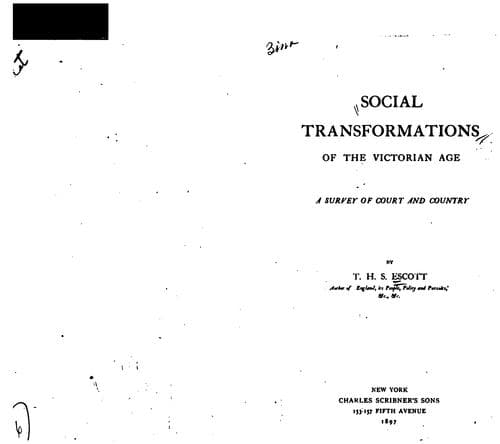
Social Transformations of the Victorian Age: A Survey of Court and CountryEscott, T. H. S. (Thomas Hay Sweet)
History
Social Transformations of the Victorian Age: A Survey of Court and Country
Escott, T. H. S. (Thomas Hay Sweet)
Great Britain -- Civilization -- 19th century; Great Britain -- Social life and customs -- 19th century
In the eyes of sober citizens of the industrial class, the life of the
soldier seemed only one degree less dismal and shameful than the career of
the hulks. As a fact the soldier's lot was perhaps half a century ago not
much more tolerable than that of the convict shipped for his offences
beyond seas. A prison with a chance of being killed in it represented in
the popular eye the existence of the private soldier. It involved
transportation with hard labour as a matter of course. One battalion first
raised in 1700 had been the whole of those 137 years abroad on active
service. When his destiny was less severe than this, a life insufferably
tedious was led by him in barracks pestilently unhealthy. To-day, upon a
different plane of comfort, and on a reduced scale of luxury, the private
soldiers may be said to enjoy the same recreations and opportunities of
improvement as his officer. He is the master of his own time during
several of the best hours in every day. He has no more difficulty in
obtaining leave up to midnight for a theatre visit than a Woolwich cadet
in getting a Sunday exeat from the Academy. Rooms for study and pastime
are provided within his barracks.
Domestic life is no longer incompatible with his military service. But in
1837 married quarters did not exist. Those who had wives and children
herded with their unmarried comrades in scandalous confusion. Whatever,
with a view of completely brutalizing if possible the men who fought their
country's battles, could in addition to these things be devised, was not
wanting. Punishments were meted out with indiscriminating severity. The
Queen had been on her throne some years before the lash was limited to
time of war. Among the officers brought up in the school of Wellington a
prejudice in favour of flogging as a simple, efficacious sort of British
punishment lingered perhaps till 1880, when on a memorable occasion after
an exciting debate that had signalized the opening of a new era of
parliamentary obstruction, the House of Commons decreed its entire
abolition. As has been already said, the policy to which the Duke of
Wellington had from political exigencies been as he thought compelled, was
to sacrifice to the maintenance of a small and often invisible body of
regulars every other branch of the Service.
Public-domain text, read in full here on John Shaqi.
Reviews
Reviews
No reviews yet
Be the first to share your thoughts on this work.
Elsewhere in the archive
Join the Discussion
Join the discussion
Sign in to leave a comment or review.
Sign InorCreate an account